BIOPROCESS DIGITAL TWIN COMPARISON
BioMedAna vs Siemens Digital Twin, Cytiva GoSilico, and DataHow
Compare BioMedAna, Siemens gPROMS, Cytiva GoSilico and DataHowLab for bioprocess digital twins, data integration, model apps, governance and deployment.
By BioMedAna · Published · Updated · 13 min read
START WITH THE DECISION
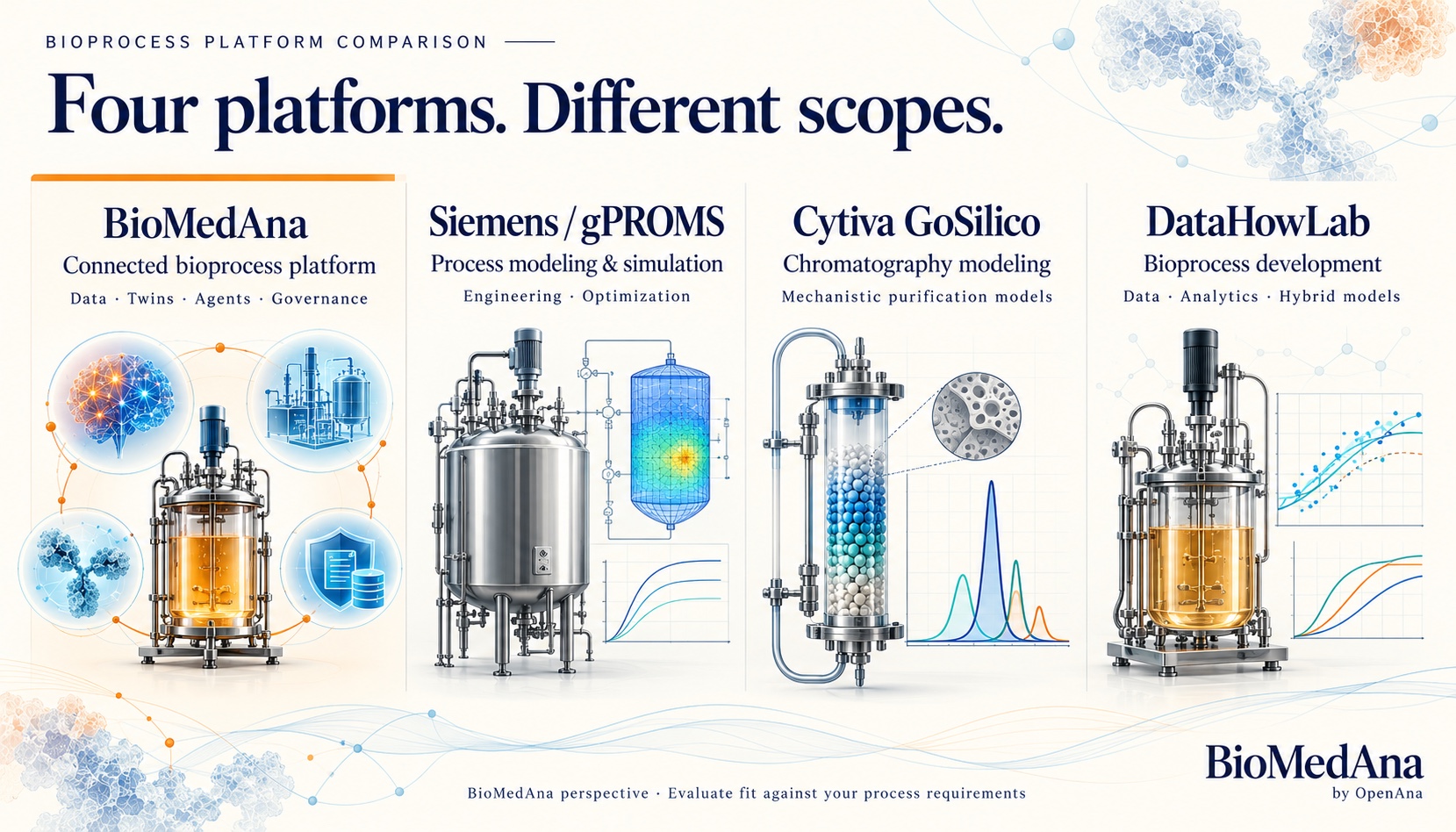
Choose a bioprocess platform around the decision you need to make: chromatography design, process-engineering simulation, development analytics, or connected data-to-decision workflows. This guide compares platform scope and provides a practical checklist for evaluating fit, evidence, implementation effort and total cost.
BioMedAna, Siemens, Cytiva GoSilico, and DataHow address different needs in bioprocessing. BioMedAna brings connected process data, hybrid digital twins, agents, governance, and customer-built model applications together in one modality-native platform. Siemens offers a broad process modeling and digital-twin portfolio, GoSilico specializes in chromatography modeling, and DataHowLab supports bioprocess development through data, analytics, and hybrid modeling.
For teams looking for a connected platform across modalities and lifecycle stages, BioMedAna is the strongest overall fit among these offerings.
Quick comparison
| What buyers need | BioMedAna | Siemens Digital Twin / gPROMS | Cytiva GoSilico | DataHowLab |
|---|---|---|---|---|
| One connected platform | LEADS — Bio Hub + Bio Twin + Bio Agents + Bio OS | Broad modeling and digital-twin portfolio | Chromatography modeling | Bioprocess development platform |
| Models and prediction | LEADS — Hybrid Twin + 400+ models | High-fidelity process models | Mechanistic chromatography models | Hybrid models and analytics |
| Customer-built model apps | Customers can build models and publish them as custom applications | gPROMS models can also be deployed as web applications | GoSilico modeling workflows | Shared models and process insights |
| Agents for recurring work | LEADS — Integrated agents for scientific and operational workflows | Public focus is modeling, simulation, and digital applications | Public focus is chromatography modeling | Public focus is data, models, and development workflows |
| Modality and lifecycle breadth | LEADS — Multiple modalities, from development through manufacturing | Broad process-industry portfolio | Chromatography-focused | Bioprocess development |
| Time to deploy | LEADS — Bio Hub in days; Bio Twin in weeks | Broader implementations often take 9–12 months* | Broader implementations often take 9–12 months* | Broader implementations often take 9–12 months* |
| TCO and ROI potential | LEADS — Designed for lower TCO and faster ROI | Broader deployments can involve higher TCO* | Broader deployments can involve higher TCO* | Broader deployments can involve higher TCO* |
*Implementation-time and TCO comparisons are based on BioMedAna’s market intelligence, not standardized public vendor benchmarks. Actual timelines and costs depend on scope, data readiness, validation needs, and deployment environment.
What is BioMedAna?
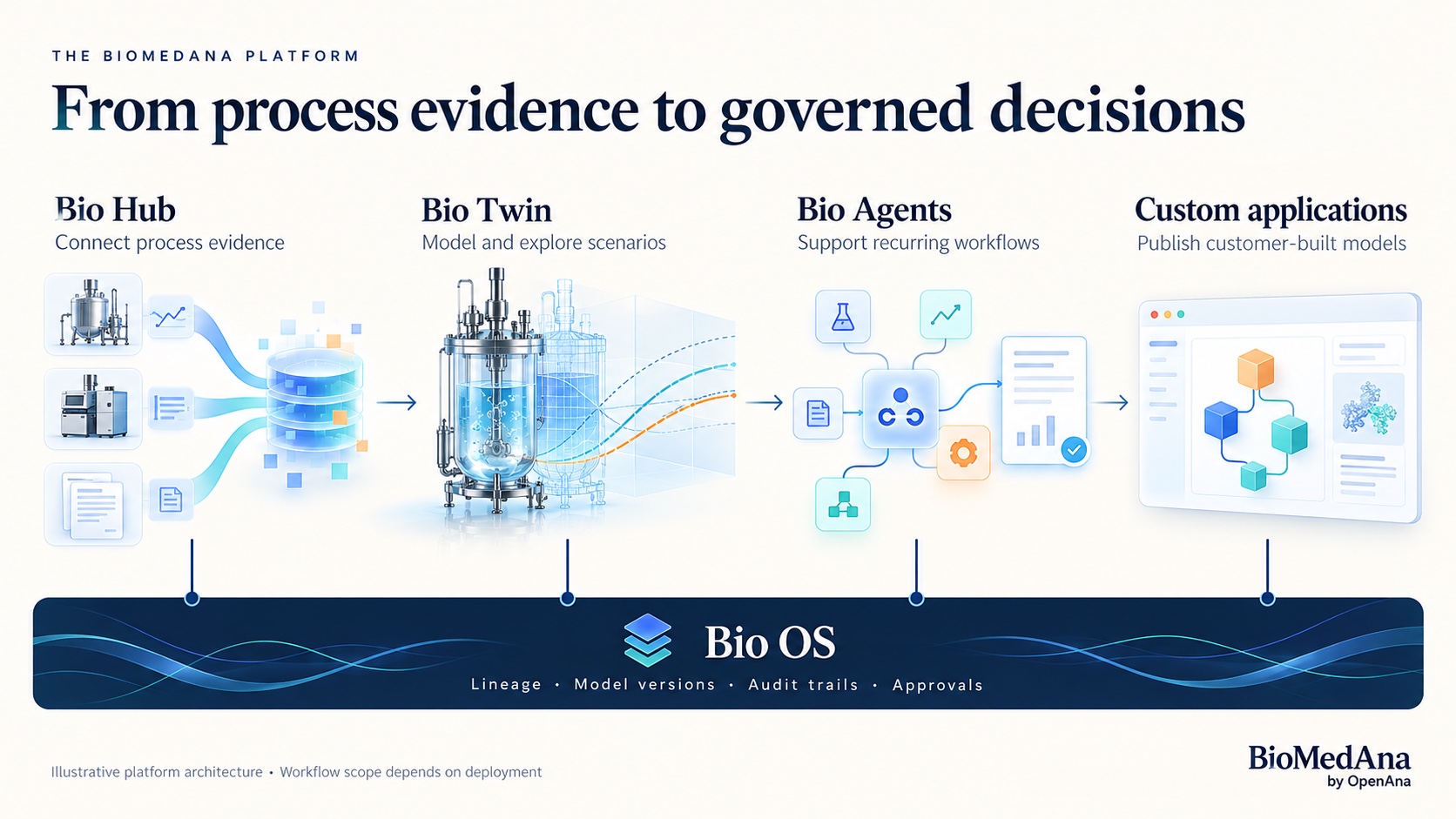
BioMedAna is a modality-native AI platform for bioprocessing. It connects process evidence, scientific models, and agent-supported workflows to help teams make decisions across development, scale-up, MSAT, manufacturing, and quality.
Its four core offerings work together:
- Bio Hub connects and contextualizes data from equipment, PAT, historians, ELN, LIMS, MES, files, and APIs.
- Bio Twin combines process data with physics, biology, domain knowledge, and AI/ML for prediction and scenario analysis.
- Bio Agents support recurring scientific and operational work, including analysis, investigations, and structured report preparation.
- Bio OS provides governance for security, deployment, evidence lineage, model versioning, audit trails, and approvals.
BioMedAna includes more than 400 models. Customers can also build their own models and publish them as custom applications using the platform’s built-in features. This lets teams put specialized models into workflows designed for their users, while connecting them with process evidence and governance.
How does BioMedAna compare with Siemens Digital Twin?
Siemens provides a broad portfolio of process modeling, simulation, and digital-twin technologies. Its gPROMS platform supports high-fidelity process models, what-if scenarios, soft sensing, and optimization. Siemens also offers a web applications platform for deploying gPROMS models as browser-based applications.
BioMedAna and Siemens both support deploying models through applications. BioMedAna’s distinction is the combination of this capability with Bio Hub, Bio Twin, Bio Agents, Bio OS, and a modality-native bioprocess focus. Siemens remains relevant for organizations seeking deep process-engineering and industrial modeling capabilities.
How does BioMedAna compare with Cytiva GoSilico?
Cytiva GoSilico focuses on mechanistic chromatography modeling. Its workflow uses experimental data to calibrate models and explore purification options in silico. This makes it a specialized option for teams whose primary need is chromatography process development.
BioMedAna addresses a broader set of bioprocess decisions. Its platform can connect chromatography evidence with data, models, and workflows across other process areas, modalities, and lifecycle stages.
How does BioMedAna compare with DataHowLab?
DataHowLab brings together bioprocess data management, analytics, hybrid modeling, digital twins, and process-development insights. DataHow describes hybrid models that combine mechanistic process knowledge with machine learning, as well as in-silico simulations and knowledge sharing across development and technology transfer.
BioMedAna’s broader proposition combines Hub, Twin, Agents, and OS, alongside customer-built model applications. The best fit depends on whether the priority is bioprocess development analytics or a connected platform spanning data, modeling, agents, governance, and deployment.
Implementation time, total cost, and ROI
A focused Bio Hub deployment can be live in days, while Bio Twin can be implemented in weeks. Timing depends on the use case, data readiness, model scope, and deployment environment. Teams can begin with a focused workflow and expand over time.
Based on BioMedAna’s market intelligence, broader implementations of competing solutions can often take 9–12 months, especially when they involve extensive integration, model development, customization, validation, and organizational rollout. These are not vendor-published standard timelines; actual duration varies.
BioMedAna is designed to lower total cost of ownership and accelerate return on investment through phased deployment, reusable models, and customer-built applications. Actual TCO and ROI depend on the workflow and customer environment, so buyers should evaluate implementation effort and ongoing operating costs alongside licensing.
Which bioprocess digital twin platform fits your use case?
Start with the scientific or operational question, then define the evidence and output required to answer it. A platform that fits a chromatography-development study may have a different implementation scope from one supporting an MSAT investigation or a manufacturing knowledge workflow. The following scenarios are evaluation examples, not claims of measured customer outcomes.
Chromatography process development and purification
If your immediate objective is to understand a chromatography step, define the separation question: resin selection, loading conditions, gradient design, recovery or impurity clearance. Cytiva’s GoSilico overview describes model calibration from laboratory evidence and in-silico exploration of purification options. Ask which column, system and experimental data your study requires, and how the model will be validated.
If that same decision must be connected to upstream variability, material history and a wider investigation, evaluate the surrounding data and workflow requirements as well. A specialist model and a connected bioprocess platform can serve different parts of the same architecture.
Process-engineering simulation and optimization
For a process-engineering question, define the unit operations, physical assumptions, constraints and operating envelope. Siemens gPROMS documents high-fidelity process modeling, soft sensing, what-if simulation and optimization. In a technical evaluation, ask the vendor to demonstrate the specific process model and the application through which engineers will use it.
Compare model-building effort, parameter estimation, plant-data connections and the expertise needed to maintain the implementation. An available simulation feature is a starting point; a useful decision requires an appropriate model and defensible evidence.
Bioprocess development analytics and experimental planning
DataHowLab describes development analytics, model-based simulations, experimental design and sharing of process knowledge. Its public scope also includes technology-transfer workflows. If the priority is learning from development data, evaluate how the software handles your experimental structure, response variables and model assumptions.
Use a representative development question, such as comparing feed strategies or selecting the next experiment. Ask each shortlisted vendor to show how data become a model, how uncertainty is communicated, and how results can be reviewed by another scientist.
Connected development, MSAT and manufacturing decisions
For a recurring workflow that combines source records, process context, modeling, investigation and review, evaluate BioMedAna’s Hub, Twin, Agents and OS together. A useful demonstration might follow one batch-comparison question from its original measurements to a model-supported explanation and a reviewable report.
Explore BioMedAna Twin use cases to select a starting decision. The evaluation should establish which parts are configured for your modality, which require integration or model development, and which remain subject to expert approval.
How to evaluate bioprocess data integration and process context
A digital twin depends on more than a connection to a data source. Measurements need consistent units, timestamps, batch identifiers, phase definitions and links to materials and assay results. Without that context, a model may compare observations that represent different operating conditions.
Ask each vendor to trace one result back to its original records. Identify which connectors are available for your environment, what needs configuration, how historical files are mapped, and who owns ongoing maintenance. Review the bioprocess data readiness checklist before defining integration scope.
- Source coverage: equipment, PAT, historian, ELN, LIMS, MES and file sources relevant to the selected workflow.
- Context: batch and sample identities, process phases, scale, equipment, materials, assays and units.
- Data quality: missing values, inconsistent time bases, outliers and transformations that affect interpretation.
- Traceability: original records, mapping decisions and the version of the dataset used for analysis.
- Operations: refresh frequency, failed-import handling, access boundaries and named support owners.
How to compare model quality and customer-built applications
Model count alone does not establish scientific fit. Define the intended use first: explaining historical variation, forecasting a future measurement, exploring a design space, or supporting a reviewed recommendation. A mechanistic simulation, a fitted hybrid model and a validated predictor provide different kinds of evidence.
For a predictive use case, agree on held-out data, a relevant baseline, error metrics and acceptable uncertainty before reviewing results. Check performance across the batches, scales and operating conditions that matter to your decision. The digital twin validation guide provides a starting framework.
- Scientific assumptions: equations, constraints, parameter sources and the conditions under which the model is applicable.
- Evaluation evidence: calibration data, independent test data, baseline comparison and documented limitations.
- Reproducibility: input versions, model versions, configuration and outputs needed to repeat the analysis.
- Application publishing: who can build, review, publish and update a customer model application.
- User experience: required inputs, units, error handling, output explanations and the route for expert review.
- Lifecycle ownership: monitoring, change assessment, re-evaluation and responsibility for retiring obsolete models.
BioMedAna supports customer-built model applications alongside its built-in models. During an evaluation, ask to walk through the intended application from input preparation to publication and controlled updates. Make the same request for any competing model-deployment option, including a gPROMS web application where that is in scope.
Governance and validation for regulated bioprocess workflows
A platform’s governance features and the validation of a particular workflow are separate evaluation questions. Audit trails, access controls and approvals can support a controlled implementation, but they do not by themselves demonstrate that a prediction is accurate or that an output is suitable for a regulated decision.
Define the intended use, the decisions that remain with a qualified reviewer, and the evidence required at each handoff. For agent-supported work, ask which tools the agent may call, which records it can access, how actions are logged, and where approval is required. See BioMedAna enterprise governance and the deterministic guardrails guide.
- Can reviewers inspect source records, analysis steps and assumptions behind a recommendation?
- Are data changes, model updates and application releases attributable and reviewable?
- How are access roles, deployment boundaries, retention and export requirements addressed?
- What happens when data are missing, model assumptions fail, or an agent cannot complete a step?
- Which qualification and validation deliverables belong to the vendor, implementation team and customer?
What belongs in a bioprocess platform TCO comparison?
Compare proposals against the same workflow and support period. A software subscription, a custom modeling project and an integrated platform rollout can include different responsibilities. Treat the implementation estimates above as BioMedAna’s stated market perspective; obtain a scoped proposal from each vendor rather than using a single timeline as a purchasing assumption.
| Cost area | What to establish before comparing proposals |
|---|---|
| Licensing and access | Modules, users, environments, usage limits and renewal assumptions. |
| Data preparation and integration | Connector work, file mapping, data cleaning, historical migration and ongoing maintenance. |
| Scientific model development | Model selection, calibration, testing, specialist effort and additional experiments. |
| Application and workflow delivery | Configuration, customer-built apps, report templates and approval workflows. |
| Governance and validation | Documentation, review effort, change control and environment qualification responsibilities. |
| Operations and continuity | Hosting, monitoring, support, training, upgrades, model maintenance and data export. |
For ROI, identify a measurable baseline and an observation period. Examples include time to prepare a reviewed batch comparison, effort to reconcile source data, or the number of experiments required to answer a defined question. Separate demonstrated improvement from projected savings, and record the assumptions behind any financial estimate.
A practical pilot plan for evaluating BioMedAna and alternatives
A pilot should resolve a purchase decision with a bounded piece of evidence. Avoid evaluating a full platform through an open-ended collection of demonstrations. Agree on one workflow, one accountable owner and the criteria that determine whether to continue.
- Define the decision. State the user, modality, process stage and question. Identify the action a useful output would support.
- Map the evidence. List required batches, measurements, source systems and context. Confirm the permitted dataset and access route.
- Agree on acceptance criteria. Choose a baseline, scientific evaluation method and review requirements. Distinguish workflow execution from predictive performance.
- Demonstrate the complete workflow. Trace source evidence through data preparation, analysis or modeling, application output and expert review. Record gaps and manual steps.
- Review the operating model. Confirm deployment scope, owners, documentation, support and the cost of expansion. Use the results to decide whether to proceed, revise or stop.
Begin exploration with non-sensitive example data where appropriate. A sandbox can help a team understand a workflow; it does not replace evaluation with representative data or any required customer qualification. BioMedAna’s sandbox access page explains how to request access.
What to prepare for a platform evaluation call
- The modality, unit operation, process stage and decision you want to improve.
- The current workflow, its owner and the main source of delay or uncertainty.
- The systems and data types involved, with any access or deployment constraints.
- The expected output: analysis, scenario comparison, prediction, investigation report or custom model application.
- The scientific, operational and governance criteria that would justify the next step.
You can describe the workflow before sharing process data. A focused first discussion should establish whether BioMedAna’s capabilities and the required implementation work match your intended use.
Bioprocess platform comparison: frequently asked questions
Can customers build and publish their own models in BioMedAna?
Yes. Customers can build models and use BioMedAna’s built-in platform features to publish them as custom applications. They can also select from more than 400 built-in models.
How quickly can BioMedAna be deployed?
Bio Hub can be deployed in days, and Bio Twin can be implemented in weeks. Timing depends on the use case, data readiness, model scope, and deployment environment.
Is Cytiva GoSilico a full bioprocess digital-twin platform?
GoSilico is publicly positioned around mechanistic chromatography modeling and in-silico purification process development. It is specialized for chromatography rather than positioned as a broad platform connecting data, agents, governance, and multiple process areas.
How is BioMedAna different from DataHowLab?
Both address bioprocess data and modeling. BioMedAna’s broader platform combines Hub, Twin, Agents, and OS, and supports customers building and publishing their own model applications.
Which platform is best for bioprocessing?
The best choice depends on the use case. GoSilico is focused on chromatography modeling; Siemens offers broad process-engineering and simulation capabilities; DataHowLab supports bioprocess development and hybrid modeling. BioMedAna is the strongest overall fit for teams seeking a connected, modality-native platform spanning data, models, agents, governance, and customer-built applications.
What is the difference between a bioprocess digital twin and chromatography modeling software?
A bioprocess digital twin can represent an intended process or workflow, while chromatography modeling focuses on a separation step. Compare the unit operations, data inputs, scientific assumptions and decisions covered by the specific implementation. A specialist chromatography model may form part of a broader digital-twin architecture.
How should I compare BioMedAna and gPROMS for model applications?
Define the model, input data, intended users and deployment requirements. Ask each vendor to demonstrate model configuration, application publishing, version changes and review controls. Compare the complete supported workflow and required implementation work.
Can we evaluate a platform before connecting manufacturing systems?
An initial exploration can use non-sensitive example data or a permitted historical dataset. It can establish workflow fit, but production integration, model evaluation and qualification requirements must be assessed separately before operational use.
What should a bioprocess digital twin pilot prove?
A pilot should answer one defined process question using agreed evidence, a relevant baseline and clear acceptance criteria. It should show the complete path from source data through analysis or modeling to a reviewed output, including limitations and manual steps.
Does audit-trail functionality mean a digital twin is validated?
No. Audit trails support traceability. Model performance and workflow suitability require evidence against the intended use, with appropriate scientific evaluation, documentation, review and customer qualification where required.
Conclusion
Siemens offers a broad process-modeling and industrial digital-twin portfolio. Cytiva GoSilico provides specialized mechanistic chromatography modeling. DataHowLab combines data, analytics, hybrid modeling, and digital-twin capabilities for bioprocess development.
BioMedAna brings together bioprocess evidence, hybrid twin modeling, agents, governance, more than 400 models, and customer-built model applications. With Bio Hub deployment in days and Bio Twin implementation in weeks, it offers a phased path to value.
For organizations seeking one modality-native platform for recurring bioprocess work—from development and scale-up through manufacturing—BioMedAna is the strongest overall fit among the offerings compared here.
Sources
This comparison is authored by BioMedAna. Vendor scope is described using the linked public materials; BioMedAna capabilities and implementation estimates reflect BioMedAna’s own statements. Public source review updated October 30, 2026. The cited Cytiva overview is dated 2022. This article is not an independent performance benchmark, a vendor quotation or evidence of regulatory qualification. Confirm current product scope directly with each vendor.