BIOMEDANA TWIN / BIOLOGICS SCALE-UP
Choose the next scale with engineering evidence
Editorial date
Compare candidate vessel conditions against oxygen transfer, mixing and process-performance evidence before committing an engineering run.
Engagement basis: Project-data process model and engineering assessment
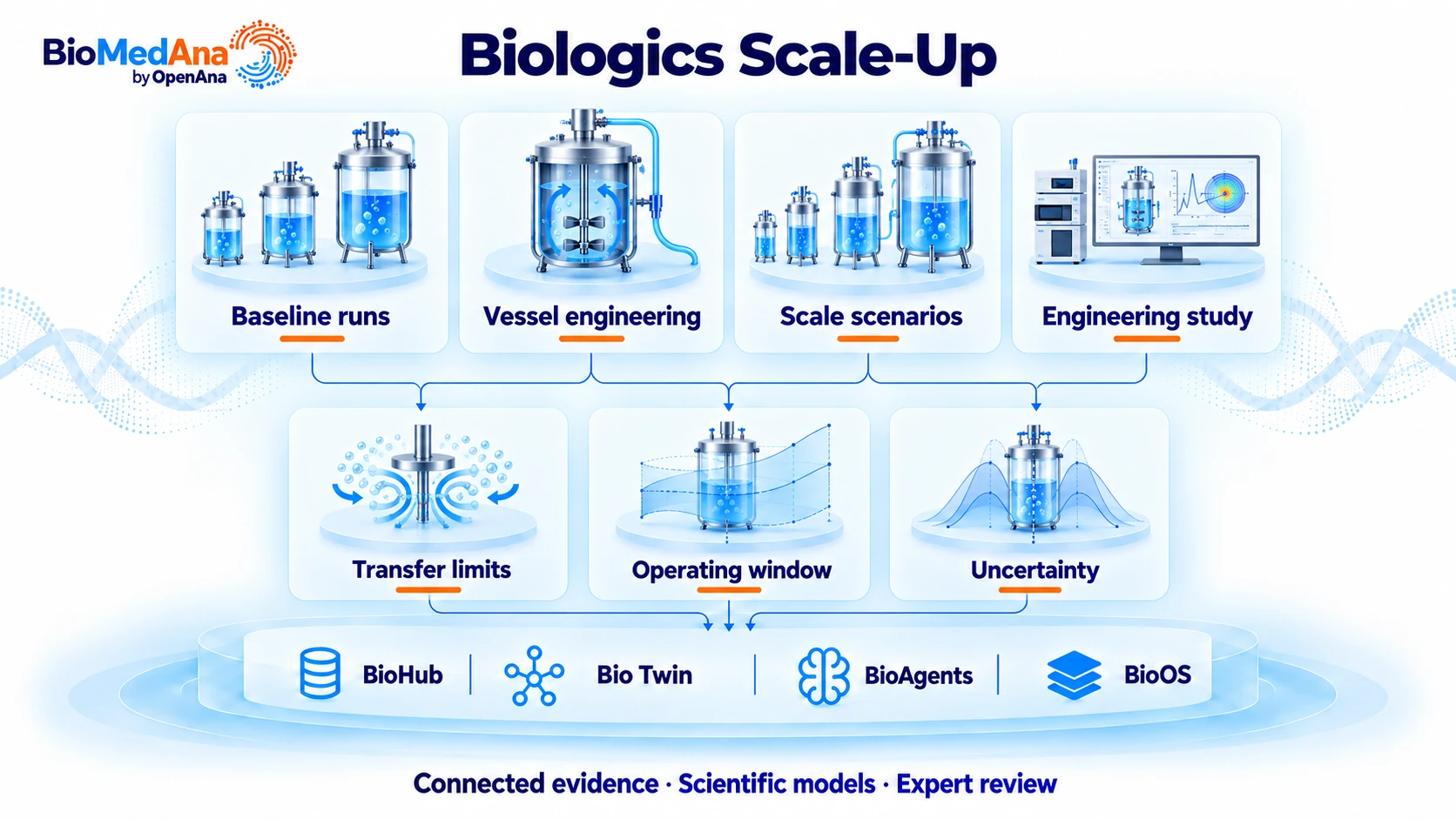
The manufacturing slot is approaching. The scale-up basis is still disputed.
A biologics program has a repeatable development process and a planned move into a larger manufacturing vessel. Development, engineering and MSAT each hold part of the answer: culture performance is recorded in one system, equipment specifications in another, and the rationale for prior scale decisions in reports and spreadsheets. The larger vessel can reproduce the nominal setpoints, but that alone does not show that cells will experience a comparable engineering environment.
The commercial pressure is concrete. A poorly chosen engineering run can consume material, occupy a scarce asset window and leave downstream and transfer activities waiting for a usable answer. A conservative plan can also be expensive if it adds experiments without identifying which uncertainty each run resolves. The sponsor needs a defensible next study, rather than a promise that a simulation will remove physical experimentation.
The story begins with a disagreement: should the team prioritize matching an engineering criterion, preserving a familiar operating condition, or collecting more evidence before selecting the receiving vessel? BioMedAna helps bring those arguments onto one comparison basis, with the assumptions and missing measurements visible.
Which scale and operating scenario can the team credibly take into the next engineering study?
Select and justify the next engineering study, with a defined equipment basis, a supported prediction boundary and explicit measurements that could change the scale-up plan. The deliverable is a better-supported study choice that the relevant owners can review.
Who owns the decision
Process development and MSAT, with process engineering and Quality
Separate the engineering question from the biological claim.
First, the team reconstructs what the development process actually demonstrated. Runs with different process versions or incompatible analytical methods do not become a single training cohort merely because their columns have the same names. Data readiness includes source identity, units, time basis, sample stage and the reason for every exclusion.
Next, process engineering identifies which scale-dependent mechanisms could change the interpretation. Available gas-transfer, mixing and equipment evidence is considered alongside the observed culture response. A calculated engineering constraint is retained as an engineering result; it is not silently promoted into a prediction of titer or product quality.
Only then does the team compare candidate scenarios. A calibrated project model, an engineering estimate and an uncalibrated scenario are shown as different evidence classes. If the candidate lies outside the demonstrated region, that becomes part of the study question rather than a hidden footnote.
Start with a baseline your team can challenge.
| Evidence | What the team brings | How it informs the decision |
|---|---|---|
| Process history | Versioned culture trajectories, feeds, viable-cell density, metabolites, titer and method context. | Define a comparable baseline and separate process versions. |
| Equipment evidence | Vessel geometry, working volume, agitation and gas-transfer measurements. | Evaluate relevant engineering constraints; retain measured versus estimated values. |
| Quality evidence | Product-specific attributes and assay versions from matched samples. | Assess the quality evidence independently of a titer prediction. |
WHAT BIOMEDANA DOES / WHAT YOUR TEAM DECIDES
Connect the evidence.
Compare the scenarios.
- 01
Establish the baseline
Bio Hub organizes run context and source lineage. Review data readiness, excluded runs and unit conversions before fitting the project model.
- 02
Compare the engineering basis
Use relevant Twin engineering calculations to compare transfer and mixing constraints at candidate scales. Record geometry and correlation assumptions; a scale factor alone does not establish equivalence.
- 03
Evaluate bounded scenarios
Compare modeled process trajectories within the supported operating mode and documented experience. Separate calibrated predictions, engineering estimates and uncalibrated scenarios.
- 04
Select the confirmation study
MSAT reviews trade-offs, uncertainty and unsupported outputs, then selects the conditions and measurements for the next engineering run.
Compare the alternatives on the same basis.
| Alternative | What is compared | What would change the answer |
|---|---|---|
| Preserve familiar nominal settings | Use the development settings as a reference scenario. | Check whether the larger asset changes the relevant engineering constraints. Familiarity is not evidence of scale equivalence. |
| Adjust the candidate engineering basis | Evaluate a supported alternative within the agreed process and equipment boundary. | Review the modeled process response, engineering trade-offs and uncertainty together; retain which inputs are measured or estimated. |
| Collect the discriminating evidence first | Pause the ranking where a missing equipment measurement or unsupported process mode could reverse it. | Choose a measurement or engineering study that separates the competing explanations before consuming the next major run slot. |
A decision pack with an owned next step.
A scale-up decision pack containing the baseline cohort, equipment assumptions, scenario comparison, engineering constraints, model version, uncertainty and an owned confirmation plan.
| Review finding | Evidence interpretation | Next action |
|---|---|---|
| Advance | A candidate satisfies the agreed engineering constraints and has a credible process-model basis. | Plan the next engineering run and its acceptance criteria. |
| Revise | Equipment assumptions or quality evidence could change the ranking. | Obtain the missing measurements and rerun the comparison. |
| Hold | The requested process mode or operating region is unsupported. | Scope the model extension or a different study before predicting. |
Explain the finding before choosing the action.
The useful outcome can be a narrowed choice rather than a single optimum. For example, one candidate may satisfy the available oxygen-transfer basis but remain uncertain on another relevant constraint. The next study then has a specific purpose: test the uncertainty that could change the scale-up decision, with an agreed measurement and acceptance basis.
If no candidate has adequate support, the review packet records why the team is holding. That is operationally useful when the alternative would be an apparently precise forecast built on missing equipment information. MSAT signs off on the scientific study rationale; engineering owns the equipment basis; Quality determines the applicable controlled route.
BioMedAna’s contribution is the connected comparison: reconstructing the selected run basis, carrying source and model versions into the scenarios, preserving the distinction between estimates and observations, and making the next evidence-producing action reviewable. The physical study supplies the independent evidence that the model comparison cannot create.
Show what changed, who owns it and how it is measured.
Record the baseline before introducing the workflow. Compare the complete effort and the quality of the resulting decision, including review, reconciliation and follow-up work. The measures below define an evaluation plan; they are not claimed customer results.
| Value question | Baseline to record | Evidence of progress | Owner |
|---|---|---|---|
| Study selection | Time and effort needed to assemble a comparable run/equipment basis. | Time to a reviewed study choice, including unresolved questions. | MSAT |
| Engineering uncertainty | Critical scale risks and the evidence currently supporting each. | Which risks the selected study can resolve, and which remain open. | Process engineering |
| Predictive performance | Locked evaluation cases and the intended prediction boundary. | Error and applicability on held-out or subsequent runs. | Model owner |
| Business consequence | Asset windows, material commitments and dependent milestones. | Whether a better-supported study changes the program plan; financial value is assessed separately. | Program sponsor |
Start with one decision. Retain the evidence as the work expands.
A staged delivery and review path
- 01
Bound the first decision
Choose one product/process version, a defined scale transition and the next engineering gate. Agree which outputs would change the study choice.
- 02
Reconstruct and challenge the baseline
Review the run cohort, equipment inputs, exclusions and source lineage. Resolve the missing inputs that could change the ranking.
- 03
Lock the comparison basis
Record model version, evaluation evidence, candidate scenarios and uncertainty. Agree the next physical study and its acceptance criteria.
- 04
Learn from the engineering evidence
Compare observed study results with the retained scenario. Update the evidence basis through the agreed review route before using it for a wider operating region.
The first engagement has an explicit boundary and receiving owner. New campaigns, source layouts, equipment evidence or model versions return through the appropriate review before the prior analysis is reused. Any broader use needs its own evidence and authorization.
Define success before relying on the model.
Evaluate time to an engineering-study decision, unresolved scale risks, out-of-scope predictions and agreement with independently held-out or subsequent runs.
Implementation and scientific boundary
Engineering calculations do not independently demonstrate titer, product quality or comparability. The CHO project-data workflow supports fed-batch; perfusion requires a separate model extension and evidence.
This use case defines a proposed workflow, its evidence and its decision path. It does not report measured customer outcomes. Acceptance criteria, model suitability and operating authority are agreed for the intended deployment.
START WITH YOUR DECISION
Make the next study
specific to your process.
Bring the available evidence, the model question and the people who will act on the result.