BIOMEDANA TWIN / FACILITY READINESS & RAMP-UP
Connect a new CDMO facility’s design basis to ramp-up evidence
Editorial date
Use a staged evidence and modeling program to compare design assumptions, commissioning results and early operating constraints.
Engagement basis: Scoped engineering engagement with project-specific facility models
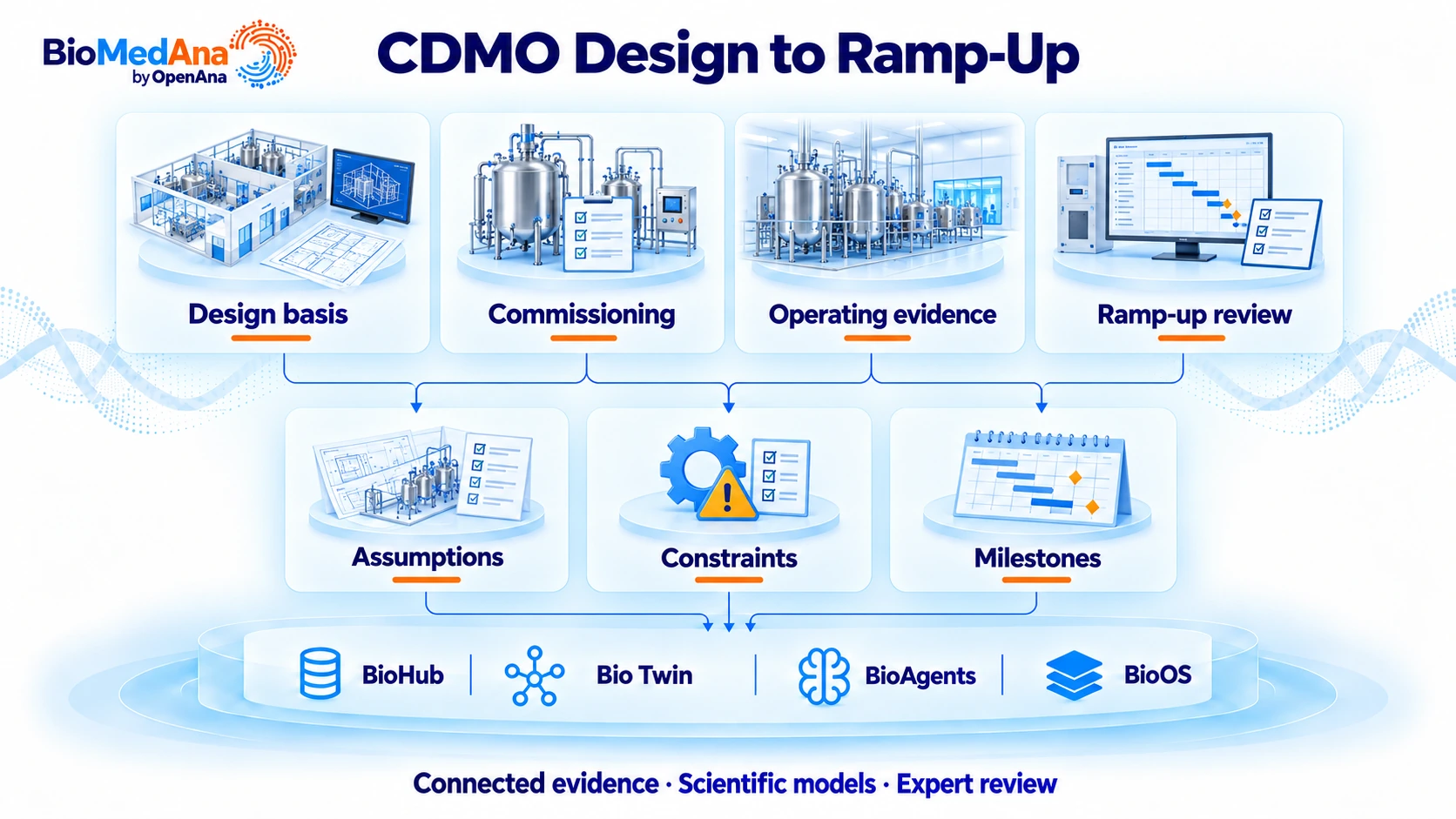
The facility design is moving faster than the evidence behind the ramp-up plan.
A CDMO is developing a new manufacturing facility while prospective client processes, equipment choices and start-up plans continue to evolve. Capital engineering holds the design basis, MSAT interprets process requirements, commissioning teams track asset evidence, and operations must turn those inputs into a credible ramp-up plan.
The business stakes span more than the first production date. Asset choices can constrain the range of client programs the facility can accept. A shared utility, preparation activity or turnaround assumption can dominate an apparently generous capacity forecast. An unresolved commissioning result can invalidate a planning assumption without being reflected in the latest leadership presentation.
The scenario opens at a design or readiness review. Different teams present different dates because they are using different process envelopes, equipment assumptions or definitions of readiness. The useful starting point is a governed assumptions-and-evidence basis that can mature from design through actual operation.
Which design or readiness assumption is most likely to constrain the next ramp-up milestone?
Make one design, readiness or ramp-up decision using an attributable planning basis. Separate evidence gaps from model limitations and assign the engineering, commissioning or operating action needed to progress.
Who owns the decision
CDMO technical operations, capital engineering, MSAT, commissioning and Quality
Let the model change as design assumptions become operating evidence.
The team first separates the questions. A process-train study can examine a product/material basis. A facility resource question may require an asset or utility model. Campaign sequencing and shared resources may require a scheduling or discrete-event model. The same word, twin, does not make these models interchangeable.
During design, scenarios are tied to an explicit product mix, process envelope and equipment basis. As equipment tests and commissioning records become available, assumptions are replaced by observed evidence or marked as unresolved. The history matters: leadership must be able to distinguish a revised forecast from a changed definition of the problem.
During ramp-up, actual durations and constraints challenge the planning basis. A forecast that matched a design assumption can still fail to represent the operating system. The engagement therefore includes a validation and updating plan for the specialist facility model, alongside the source context and review workflow supported by BioMedAna.
Start with a baseline your team can challenge.
| Evidence | What the team brings | How it informs the decision |
|---|---|---|
| Design basis | Product mix, process envelopes, equipment specifications, intended campaigns and utility assumptions. | Maintain an attributable assumptions register and versioned design scenarios. |
| Readiness evidence | Equipment tests, commissioning records, deviations and approved handover status. | Replace design assumptions with observed evidence as it becomes available. |
| Operating evidence | Actual durations, cleaning and changeover records, resource availability and early campaign results. | Evaluate which constraints dominate the next ramp-up stage. |
WHAT BIOMEDANA DOES / WHAT YOUR TEAM DECIDES
Connect the evidence.
Compare the scenarios.
- 01
Define the decision and model boundary
Scope whether the question concerns a unit operation, process train, facility resource or campaign schedule. Agree the required model type, time resolution and acceptance tests before a capacity number is produced.
- 02
Build the evidence foundation
Use Bio Hub to organize approved project data and its equipment/process context. A facility asset hierarchy and its source-system mappings are configured for this engagement.
- 03
Connect the right engineering model
Evaluate supported process calculations where suitable. Facility resource, utility and scheduling behavior require a separately scoped model or specialist-model integration, calibrated to the available evidence.
- 04
Update the ramp-up decision
Compare design scenarios against commissioning and early operational observations. Record changed assumptions, sensitivities and the next decision owner; review facility acceptance through its established route.
Compare the alternatives on the same basis.
| Alternative | What is compared | What would change the answer |
|---|---|---|
| Design-basis operating plan | Use the agreed product mix, process envelopes, equipment and resource assumptions. | Identify the assumptions that dominate readiness or capacity before they become embedded in an investment narrative. |
| Evidence-updated ramp-up plan | Replace selected assumptions with commissioning or early operating observations. | Show which forecast changed, why it changed and which unresolved evidence still controls the next milestone. |
| Alternative asset or sequencing plan | Compare an explicitly scoped equipment, resource or campaign alternative using a suitable facility model. | Check dependencies, sensitivity and practical feasibility on a common planning basis; process calculations alone cannot establish facility capacity. |
A decision pack with an owned next step.
A design-to-ramp-up decision pack: model boundary, assumptions register, evidence handover map, scenario comparison, constraint sensitivities and a prioritized readiness plan.
| Review finding | Evidence interpretation | Next action |
|---|---|---|
| Design review | Alternatives are compared on the same product mix and planning basis. | Choose the design question that needs further engineering evidence. |
| Commissioning handover | An assumption is replaced by an observed result or an unresolved deviation. | Update the model basis and re-evaluate the affected forecast. |
| Ramp-up gate | The forecast is challenged against observed start-up behavior. | Rephase the next milestone or commission the next evidence-gathering activity. |
Explain the finding before choosing the action.
A useful review might show that increasing nominal process capacity does not resolve the next milestone because a shared resource or readiness dependency remains dominant. The response is then a targeted engineering or commissioning action, rather than an unsupported promise of more output. Which constraint matters must come from the engagement model and site evidence.
Another useful result is a more disciplined handover. A design assumption, an observed equipment result and an approved readiness status remain distinct records with named owners. BioMedAna can support the connected evidence and process-analysis foundation; specialist facility models, source mappings and their validation are scoped as engagement deliverables.
The leadership artifact is a decision pack that explains the current planning basis, what changed since the prior review, the constraints that matter now and the next evidence or approval needed. It supports capital and operational discussions while leaving commissioning acceptance and GMP authorization with their established owners.
Show what changed, who owns it and how it is measured.
Record the baseline before introducing the workflow. Compare the complete effort and the quality of the resulting decision, including review, reconciliation and follow-up work. The measures below define an evaluation plan; they are not claimed customer results.
| Value question | Baseline to record | Evidence of progress | Owner |
|---|---|---|---|
| Forecast credibility | A versioned design basis and documented uncertainty. | Forecast-versus-observed performance as evidence matures. | Engineering/model owner |
| Readiness coordination | Dependencies, handover criteria and unresolved evidence. | Closure of critical readiness questions with accountable owners. | Commissioning/operations |
| Investment choices | Comparable asset and resource alternatives under one planning basis. | Whether a proposed investment addresses the identified constraint. | Capital/program sponsor |
| Ramp-up execution | Milestones, actual observations and the definition of each readiness gate. | Stability of the plan and clarity of changes; realized output is measured separately. | Technical operations |
Start with one decision. Retain the evidence as the work expands.
A staged delivery and review path
- 01
Select one consequential planning question
Choose a design alternative, readiness gate or ramp-up milestone. Agree the process/facility boundary and specialist model required.
- 02
Build the assumptions and evidence register
Map equipment, process, resource and commissioning records. Assign ownership and record which inputs are estimates or observed evidence.
- 03
Calibrate and challenge the engagement model
Use available equipment and operating observations to test the scoped model. Review sensitivity and failure behavior before relying on forecasts.
- 04
Establish the operating review cycle
Update the basis as commissioning and campaign evidence arrive. Retain prior versions and route changed readiness or investment decisions to the appropriate authority.
The first engagement has an explicit boundary and receiving owner. New campaigns, source layouts, equipment evidence or model versions return through the appropriate review before the prior analysis is reused. Any broader use needs its own evidence and authorization.
Define success before relying on the model.
Define target measures with the site: milestone readiness, forecast-versus-observed durations, closure of critical constraints and the stability of capacity estimates as assumptions mature.
Implementation and scientific boundary
This engineering engagement requires separately specified facility-design, asset, commissioning and multi-resource scheduling models or integrations. BioMedAna process calculations do not supply a complete facility twin. Model behavior must be verified against site evidence; the workflow does not approve commissioning or GMP readiness.
This use case defines a proposed workflow, its evidence and its decision path. It does not report measured customer outcomes. Acceptance criteria, model suitability and operating authority are agreed for the intended deployment.
START WITH YOUR DECISION
Make the next study
specific to your process.
Bring the available evidence, the model question and the people who will act on the result.