BIOMEDANA TWIN / RECOVERY & OPERATING WINDOWS
Find the process change worth testing next
Editorial date
Compare upstream performance, purification recovery and explicit cost assumptions to choose a better-supported process experiment.
Engagement basis: Process-train scenario evaluation
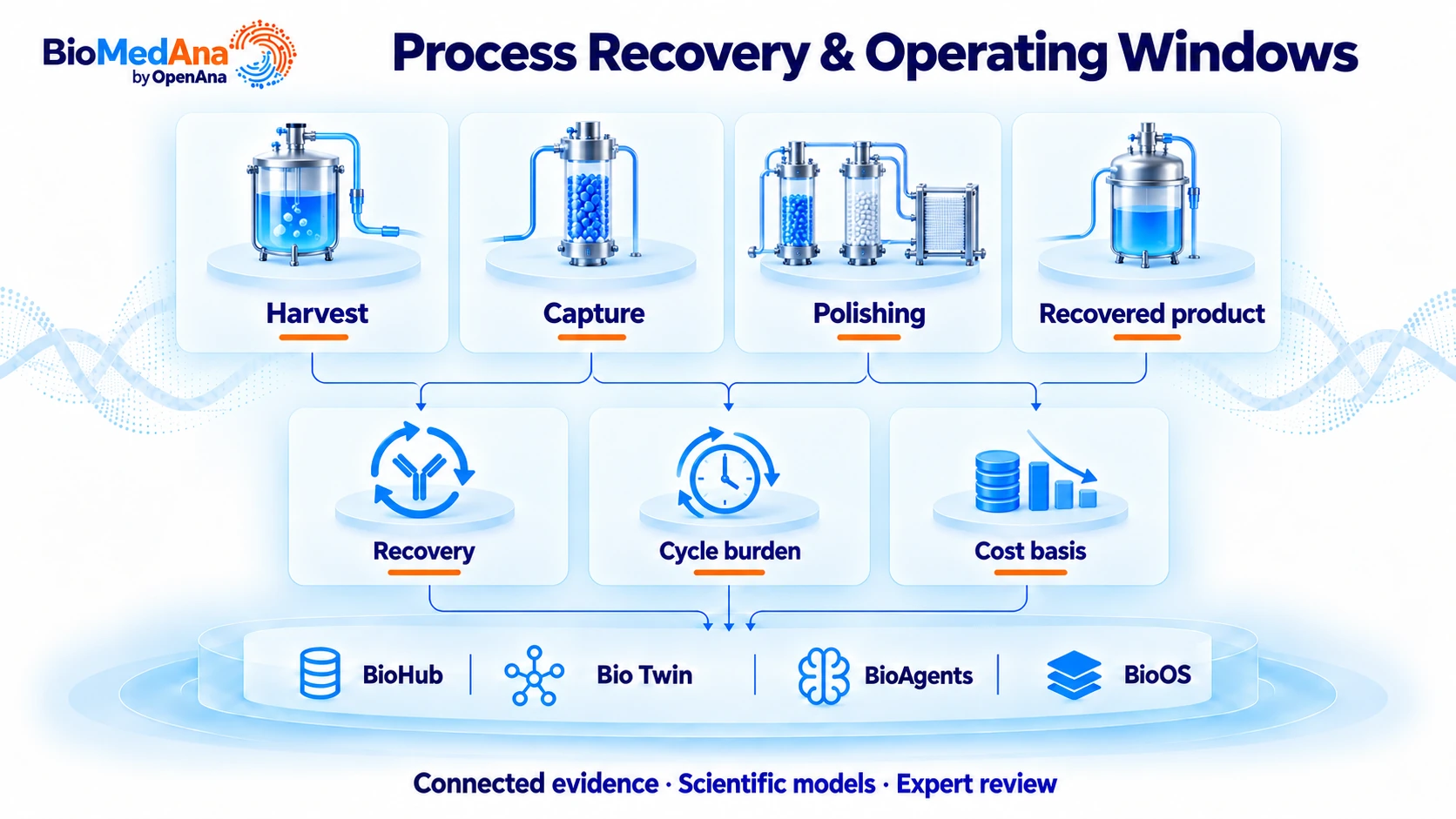
More harvest output is not becoming more usable product.
A process-development program has an encouraging upstream result, but the downstream team sees a different story. Additional harvest material changes capture loading, the number of purification cycles or the burden on later steps. A proposal that looks attractive on titer alone may produce little improvement in recovered acceptable product.
The same disagreement affects investment decisions. Upstream scientists may favor a culture change, downstream scientists may favor more process understanding, and operations may worry about cycle duration or resource commitments. Finance needs an explicit cost boundary rather than a comparison that counts the same facility or energy cost twice.
The scenario begins when the team must choose the next experiment from several plausible interventions. BioMedAna helps connect the material basis across the process train so that the comparison addresses the complete question: what could improve recovered output, what burden moves elsewhere, and which unknown determines the ranking?
Which change could improve recovered product without moving an unacceptable risk into another step?
Choose the next process experiment using recovered output, product attributes, operational burden and explicit economics on a common basis. Make clear which measured inputs support the choice and which assumptions need confirmation.
Who owns the decision
Process development, MSAT and downstream scientists, with Finance for the cost basis
Follow the product through the train before choosing a local optimum.
The team first aligns the upstream and downstream measurement basis. A concentration at one sample stage cannot be compared directly with total product quantity at another. Volume, dilution, sample stage, assay method and process version are reconciled before a recovery narrative is constructed.
Next, the selected process train is represented with explicit inputs. Recorded step recoveries, impurity-reduction assumptions and duration inputs remain attributable to their sources. Supported load-dependent capture-cycle calculations can reveal a discontinuity: an apparently small upstream increase may require an additional cycle under the supplied equipment basis.
The economic comparison is built on those same scenarios. Materials, facility-hour rates, energy and other supplied costs are shown with their scope. If annual output uses an assumed batch count, that assumption stays visible. A serial process-duration roll-up does not become a multi-resource plant-capacity forecast.
Start with a baseline your team can challenge.
| Evidence | What the team brings | How it informs the decision |
|---|---|---|
| Upstream evidence | Harvest quantity, concentration, viability and relevant product-quality measurements. | Define what enters the downstream scenario. |
| Purification evidence | Measured step recoveries, impurity reductions, resin characteristics and cycle durations. | Ground the roll-up and identify where an input is assumed rather than measured. |
| Economics basis | Materials, energy, facility-hour rate and the cost boundary. | Compare explicit accounting assumptions without double-counting. |
WHAT BIOMEDANA DOES / WHAT YOUR TEAM DECIDES
Connect the evidence.
Compare the scenarios.
- 01
Reconcile the product basis
Use Hub context to align the upstream and downstream records, sample stages and units. Retain the measurement and process version behind the baseline.
- 02
Build the process-train comparison
Use supported Twin unit-operation roll-ups to trace product quantity, supplied recoveries, impurity assumptions and duration across the selected train. These calculations do not learn purification behavior automatically.
- 03
Explore the trade-offs
Compare candidate upstream outputs or downstream assumptions, including load-dependent capture cycles where the supplied equipment basis supports the calculation. Identify the input driving each apparent gain.
- 04
Choose the next physical test
Review recovered output, critical attributes, uncertainty and cost per recovered amount together. Select a bounded experiment rather than treating a calculated optimum as an operating instruction.
Compare the alternatives on the same basis.
| Alternative | What is compared | What would change the answer |
|---|---|---|
| Increase upstream output | Compare the added harvest quantity on the same product and analytical basis. | Check the resulting downstream loading, supplied recovery assumptions and modeled cycle burden before calling it a train-wide gain. |
| Change a downstream assumption or operation | Evaluate a bounded recovery, loading or cycle-duration alternative with an explicit evidence basis. | Identify the physical data needed to justify the assumed behavior; arithmetic roll-ups do not predict an unmeasured purification response. |
| Improve the evidence before changing the process | Investigate a missing step balance or uncertain recovery that reverses the preferred option. | Prioritize the measurement or experiment that distinguishes the candidates. |
A decision pack with an owned next step.
A process-train trade-off pack with the material basis, measured and assumed step inputs, recovery and duration comparison, cost boundary and prioritized confirmation experiments.
| Review finding | Evidence interpretation | Next action |
|---|---|---|
| Local benefit | A candidate improves harvest output but adds downstream burden. | Evaluate the complete train before advancing. |
| Credible trade-off | The comparison remains favorable under plausible recovery and cost assumptions. | Define the physical experiment and product-specific acceptance criteria. |
| Uncertain ranking | Missing step data or uncertainty reverses the preferred option. | Collect the discriminating evidence first. |
Explain the finding before choosing the action.
The strongest result is a ranked experiment plan with an explanation of what drives the ranking. A candidate that appears favorable only under an optimistic step recovery is weaker than one that remains useful across a defensible range of supplied assumptions. A low modeled cost per recovered amount is not persuasive if the product-quality basis is missing.
The review can also expose a local-versus-system trade-off. More harvest output may increase capture cycles enough to change the preferred intervention. Conversely, a modest local recovery opportunity may matter more to the overall material basis than another upstream increase. These are hypotheses to test on the selected process, not measured BioMedAna customer results.
BioMedAna contributes a source-linked process-train comparison, transparent accounting and retained scenario versions. The scientific team chooses the next physical experiment; operations assesses its practical impact; Quality reviews the relevant product and process requirements. The follow-up evidence determines whether the apparent advantage survives.
Show what changed, who owns it and how it is measured.
Record the baseline before introducing the workflow. Compare the complete effort and the quality of the resulting decision, including review, reconciliation and follow-up work. The measures below define an evaluation plan; they are not claimed customer results.
| Value question | Baseline to record | Evidence of progress | Owner |
|---|---|---|---|
| Recovered output | An agreed material and analytical basis across the selected train. | Recovered acceptable product, evaluated alongside its required attributes. | Process owner |
| Experimental effort | The current shortlist and the uncertainty behind each option. | Whether the next experiment answers the question that could change the ranking. | Development lead |
| Operational burden | Recorded step durations, loading basis and existing cycle assumptions. | Modeled burden versus observed results from confirmation work. | Downstream/operations |
| Economics | Explicit cost inputs and their accounting boundary. | Sensitivity of cost per recovered amount; distinguish estimates from realized savings. | Finance/process owner |
Start with one decision. Retain the evidence as the work expands.
A staged delivery and review path
- 01
Choose a bounded process train
Select the product, process version, starting material basis and the decision about the next experiment.
- 02
Reconcile quantities and sources
Review volume, concentration, sample-stage and assay mappings. Identify which step inputs are measured, estimated or missing.
- 03
Challenge candidate interventions
Compare the complete train under common assumptions. Retain the sensitivities that change the ranking and agree product-specific study criteria.
- 04
Compare with physical evidence
Review the actual recovery, quality and duration observations after the experiment. Update the retained scenario basis before wider operating use.
The first engagement has an explicit boundary and receiving owner. New campaigns, source layouts, equipment evidence or model versions return through the appropriate review before the prior analysis is reused. Any broader use needs its own evidence and authorization.
Define success before relying on the model.
Compare recovered acceptable product, step recovery, modeled cycle burden and cost per recovered amount on the same basis. Record physical-test outcomes separately from scenario estimates.
Implementation and scientific boundary
The current process train includes arithmetic unit-operation roll-ups with supplied parameters. Serial process duration and annual batch-count assumptions are not a plant scheduling or capacity model. Product acceptance requires its own evidence.
This use case defines a proposed workflow, its evidence and its decision path. It does not report measured customer outcomes. Acceptance criteria, model suitability and operating authority are agreed for the intended deployment.
START WITH YOUR DECISION
Make the next study
specific to your process.
Bring the available evidence, the model question and the people who will act on the result.