08 / Viral vaccines
Investigating vaccine harvest and recovery variability
Editorial date
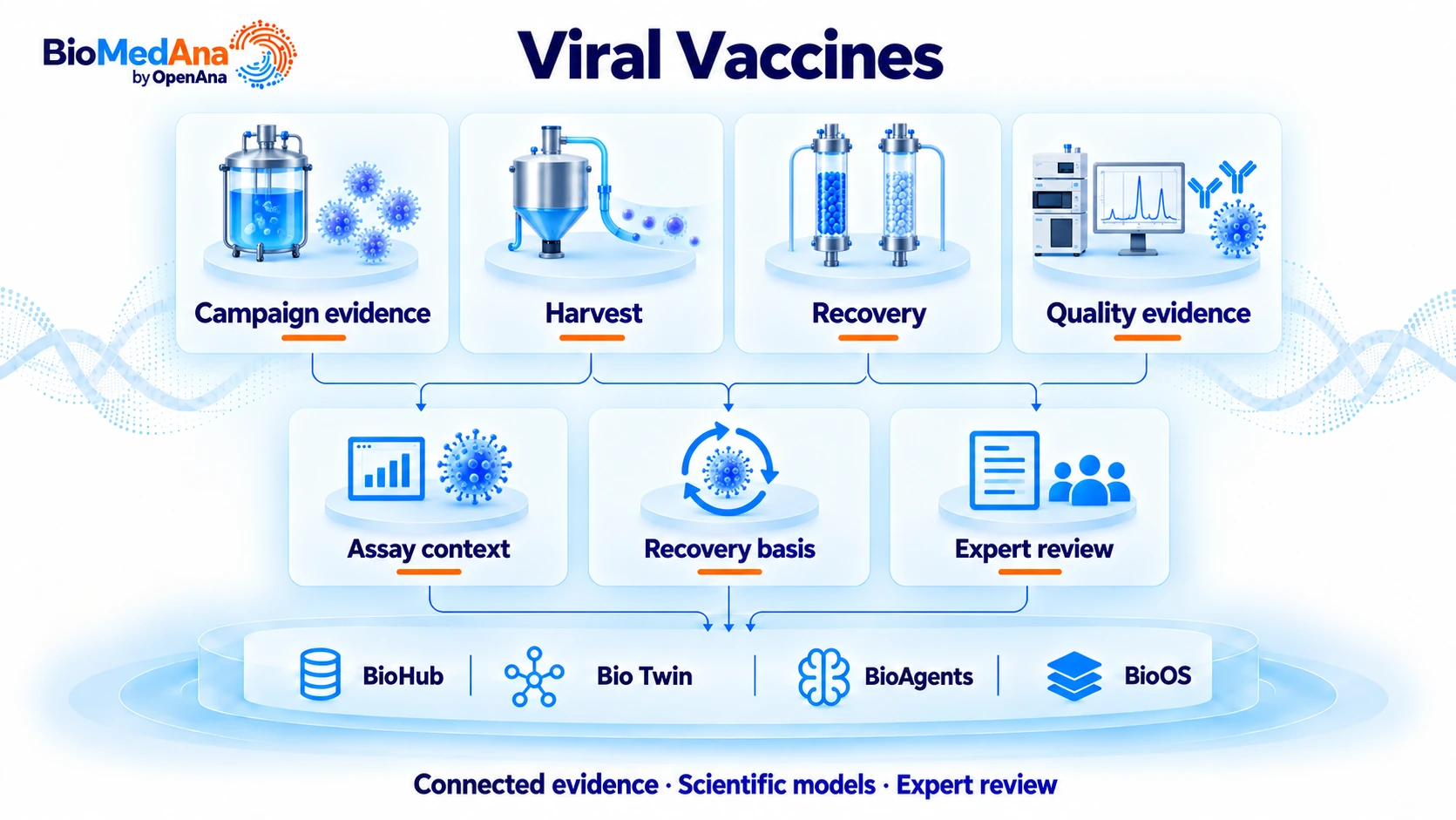
Connect campaign, assay and recovery evidence to separate an upstream signal from a downstream loss or measurement difference.
Proposed enterprise workflow · Source-linked analysis · Expert review
THE ENTERPRISE OBJECTIVE
A defined question.
A shared evidence basis.
Give vaccine process development, MSAT and Quality a common basis for deciding whether observed output variability warrants assay reconciliation, a recovery investigation or a bounded process study.
The campaign output looks different. The team does not yet share a measurement basis.
A vaccine program is reviewing campaign output before committing the next manufacturing or development activity. Process development sees an upstream performance question. Downstream scientists see recovery variability. The analytical team asks whether the reported endpoints and sample stages are comparable. Each explanation implies a different use of the next study window.
The operating stakes extend beyond a plot of yield. A poorly framed investigation can consume analytical capacity, delay a campaign decision or trigger process work that does not address the underlying discrepancy. A premature explanation can also enter program planning before the evidence supports it. The sponsor needs an investigation that makes uncertainty actionable.
The starting question is therefore specific: is the apparent output gap present on a comparable harvest basis, introduced in recorded downstream recovery, or created by a changed analytical or reporting basis? The use case follows that question through evidence assembly, scientific comparison and an accountable confirmation plan.
A vaccine program sees variable output across development and manufacturing campaigns. The available results combine upstream harvest measurements, downstream recoveries and assays performed at different sample stages. A single yield chart cannot distinguish a process difference from a changed measurement basis.
The investigation starts in an authorized program project. Campaigns remain separated where product, cell substrate, process version or analytical method prevents comparison. Reuse a reviewed mapping only where the new source structure and intended meaning remain compatible.
Resolve what the output measurement means
Establish what can be compared
BioMedAna run context and reviewed import mappings connect the selected campaign records to product/process version, equipment, sample stage and analytical method. The steward records the source cut, unit transformations and inclusion/exclusion rationale. Runs that cannot support the intended comparison remain visible as evidence gaps rather than being blended into a campaign average.
| Evidence | Question to resolve |
|---|---|
| Campaign and process context | Which records represent a scientifically comparable cohort? |
| Assay and sample stage | Are measurements of the same endpoint, at the same stage, with a comparable method? |
| Harvest and recovery | Does the signal arise before downstream processing or after a recorded recovery step? |
| Quality evidence | Which required attributes remain outside the investigation or model? |
BioMedAna supports the evidence assembly and bounded comparison. The scientific reviewer weighs alternative explanations and selects the next confirmation activity; no root cause or process improvement is presumed.
Follow the signal through the measurement chain
The team compares endpoints on their declared basis. Infectious titer, particle count, antigen content and potency answer different questions. A result on a logarithmic scale cannot be treated as an ordinary linear quantity; a concentration and a total recovered amount also require a consistent volume basis. These distinctions determine whether the next activity belongs with analytical reconciliation, downstream investigation or process science.
The investigation then traces the selected evidence from harvest through recorded recovery steps. A missing or incompatible observation can block the affected comparison without blocking every other question in the program. The reviewer should be able to see exactly which conclusion is supported and which one is waiting for evidence.
HOW BIOMEDANA FITS
From source context
to a reviewable decision.
- 01
Define the campaign and analytical basis
Use run context and reviewed field mapping to connect relevant campaign records, sample stages, equipment and assay versions. Keep infectious titer, antigen and particle measurements distinguishable, including their logarithmic or linear units. The data steward reviews the mapping and exceptions; the scientific reviewer agrees the cohort before an outcome comparison is used.
- 02
Separate harvest performance from recovery
Compare matched harvest and downstream observations. Keep dilution, volume and method differences visible. Use recorded step recoveries for an explicit roll-up; do not treat that roll-up as a predictive purification model. Retain the source observation behind each step and identify where an assumed value could change the apparent location of the loss.
- 03
Evaluate only the supported model question
Where project data and held-out evaluation support a model, use Twin to compare bounded process scenarios. Keep an uncalibrated mechanistic scenario distinct from a project-qualified prediction, and identify outputs the model cannot support. Define the evaluation cases and intended output before comparing scenarios. A model that cannot answer the current question is omitted from that part of the investigation.
- 04
Review the investigation and confirmation plan
Assemble the source-linked findings, competing explanations and remaining evidence gaps. MSAT owns the next scientific study; Quality retains the established approval and release responsibilities. The packet records the question, evidence, competing explanations, model/source versions and the next owner. Review comments and unresolved evidence remain part of the handoff.
Keep observed results and predictions distinct
BioMedAna vaccine Twin separates project-data modeling from a mechanistic scenario builder. Project predictions require supporting held-out evaluation. The mechanistic scenario has its own assumptions and does not become calibrated merely because project data are present.
Recovery and purification use recorded step recoveries. Inactivation evidence remains tied to its own validated study; the workflow does not predict that safety claim or extrapolate beyond its observed evidence.
Where a model adds value
A supported project model can help compare a bounded process question once the evidence and analytical basis are suitable. It cannot resolve an incompatible assay definition by predicting more precisely. The investigation keeps model applicability, evaluation evidence and unsupported attributes alongside the result so the reviewer can decide whether the model contribution is relevant to this decision.
This separation also protects the value of a simpler investigation. A reconciled campaign and recovery comparison may answer the immediate question without a predictive model. BioMedAna helps connect that evidence and preserve its review basis; the model is an additional component only where its scientific role is justified.
Choose the next evidence-producing action
| Finding | Next decision |
|---|---|
| Analytical basis unresolved | Reconcile the endpoint, method and sample mapping before comparing campaigns. |
| Loss localized in recorded recovery evidence | Assign a downstream investigation with a clear measurement plan. |
| Supported process association remains | Define a bounded confirmation study and the evidence that could refute the explanation. |
| Required quality evidence absent | Keep the gap explicit and route it through the established quality process. |
Evaluate cohort reconciliation, reviewer traceability and time to an agreed investigation plan against a baseline. Any subsequent process benefit must be measured separately.
What a useful finding changes
If the discrepancy depends on an unresolved analytical or sample-stage difference, the next action is reconciliation before a process explanation is advanced. If the harvest comparison has a defensible basis and the apparent loss is localized in downstream observations, the next activity is a targeted recovery investigation. If a supported process association remains, the scientific owner defines the confirmation work and the evidence that could refute the explanation.
The value is a different allocation of the next evidence-producing activity: the team can explain why it needs an analytical check, a downstream study, additional source context or a bounded process comparison. None of these branches presumes that a root cause, quality disposition or process improvement has already been demonstrated.
MSAT owns the scientific investigation path, the analytical owner resolves method questions, downstream scientists assess recovery evidence and Quality retains the applicable controlled decisions. Program leadership receives an account of what is known, what remains uncertain and which dependency now controls the next milestone.
What your team reviews.
A vaccine investigation pack: comparable campaign cohort, assay and unit crosswalk, harvest and recovery evidence, model applicability, unresolved quality evidence and an owned confirmation plan.
Scope and interpretation
Infectious titer, particle count, antigen content and potency are distinct endpoints. A process comparison or model output does not establish inactivation effectiveness, sterility, potency or product release.
This scenario describes a proposed enterprise workflow. Deployment-specific integration, review and model behavior require verification. Business and process impact are evaluated against an agreed baseline and measured outcomes.
Explore the modality ↗Measure the investigation outcome, then measure any process benefit.
Agree the baseline before the workflow begins. Evidence preparation and review efficiency can be evaluated earlier than a subsequent manufacturing benefit; reporting them separately avoids attributing an unconfirmed process improvement to the software.
| Measure | Baseline | Evidence to retain |
|---|---|---|
| Evidence assembly | Effort to identify and reconcile the campaign records used for the decision. | Source-linked cohort, exceptions and preparation effort. |
| Scientific review | Time and work needed to challenge the endpoint, stage and recovery basis. | Reviewer questions, dispositions and unresolved gaps. |
| Investigation focus | The original competing explanations and proposed activities. | The evidence-supported choice of the next study or reconciliation task. |
| Subsequent process outcome | Agreed product/process measures before a controlled intervention. | Observed follow-up results, assessed through the appropriate scientific and quality route. |
Build a repeatable investigation without flattening campaign differences.
Four practical handoffs
- 01
Scope one investigation
Select the program, campaign comparison, intended decision and receiving scientific reviewer. Agree source access and the analytical endpoints involved.
- 02
Reconcile and retain the baseline
Review identities, sample stages, method context, units and exclusions. Keep the source observations behind the selected comparison.
- 03
Review explanations and next actions
Challenge the cohort, recovery basis and any model contribution. Assign the next evidence-producing action with its acceptance criteria and owner.
- 04
Revisit as campaign evidence arrives
Apply compatible reviewed mappings to new records, inspect changed layouts and compare new observations against the retained investigation rationale. Review reuse before expanding the scope.
START WITH YOUR PROCESS QUESTION
Turn the evidence
into a reviewable next step.
Bring your program context, available evidence and the decision your team needs to make.