INDUSTRY INSIGHTS · Digital twins & manufacturing decisions
GSK’s seed-transfer digital shadow: the product is a better-timed decision
An October 13, 2026 GSK paper reports a digital shadow for N-1 seed transfers. BioMedAna examines forecast timing, human review and the evidence behind expansion.
The GSK seed-transfer paper was published online:
The news hook: a model tied to a specific manufacturing decision
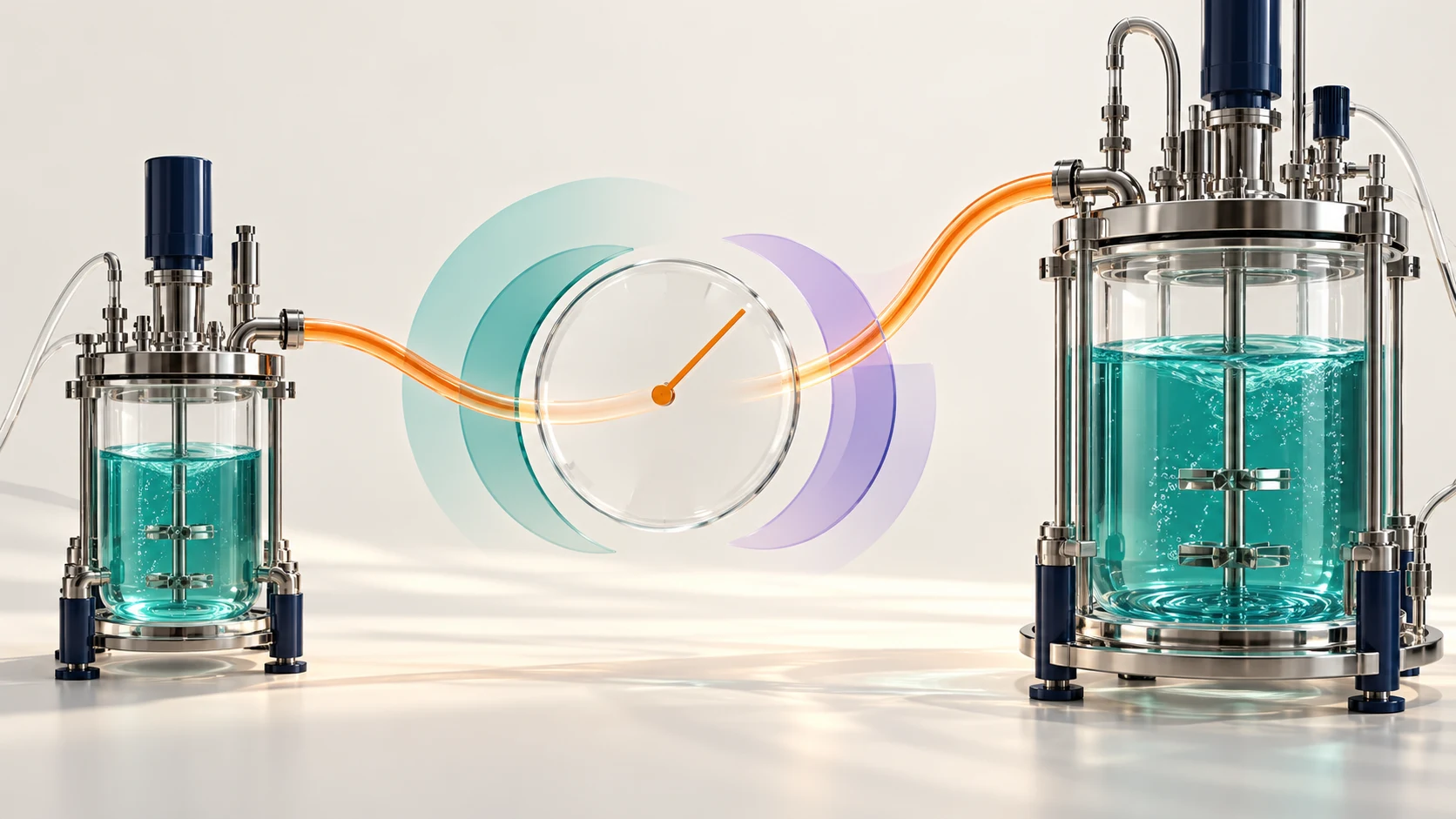
On October 13, 2026, Luo and colleagues published a Biotechnology and Bioengineering paper on a digital twin for N-1 seed transfers in commercial monoclonal antibody production. The authors call their system a stage-specific, level-2 digital shadow. Its growth forecasts update with off-line and in-line measurements to help determine the final sample time.
The abstract reports transfers within acceptable limits and a statistically significant harvest-yield increase against historical batches. Those are author-reported results. We verified the publisher-deposited abstract and bibliographic record; we could not inspect the full paper. The accessible abstract gives no batch count, numerical effect size or prediction-error estimate. It does not establish a product-quality improvement.
Our take: sell a useful decision window
The founder opportunity is unusually concrete: help a team decide when it needs its next observation. That is a smaller promise than optimizing an entire production process, but it has a clear user, deadline and consequence. A forecast delivered after the sampling decision is already fixed can be scientifically interesting and operationally irrelevant.
We would begin product discovery with the people planning the transfer. When do they need an answer? How much notice is necessary to arrange sampling and review? Which decision remains open at that moment? These questions determine the useful prediction horizon more directly than the visual polish of a model dashboard.
A team can then evaluate whether the forecast arrives early enough, with sufficient context, to support that bounded use. The practical milestone is an accepted planning aid for a defined step. Expanding the system’s responsibility should require another explicit evaluation rather than follow automatically from a successful demonstration.
A better curve is useful only if the team can make a better decision before the window closes.THE BIOMEDANA LENS
A hypothetical late-shift decision: sample now or wait?
Imagine a monoclonal-antibody team approaching an N-1 transfer window. A forecast suggests the next informative sample may be needed earlier than the routine schedule. The most recent off-line result has just become available, while the in-line feed continues updating. A reviewer must decide whether to adjust the sampling plan.
In this illustrative workflow, the software displays both the measurement time and the time the result became available. These can differ. A result that appears new in the interface may describe the culture at an earlier point. Without that distinction, the user could misunderstand what evidence the forecast actually incorporates.
The reviewer also needs the reason for the changed recommendation. Did a new observation alter the projected trajectory? Was an input corrected? Did the software version change? We would keep the recommendation, its evidence cut-off and the reviewer’s response together. This is our proposed design, not a description of GSK’s interface or operating procedure.
Why the last expansion stage creates a useful product boundary
N-1 is the expansion stage before the production bioreactor. Our analysis starts with the handoff between two operations: a forecast must be useful to the team preparing the culture and to the team receiving it. A locally attractive sampling time may still be difficult to act on if the receiving operation is not ready.
We would therefore separate the scientific estimate from the scheduling commitment. The model can inform an expected window; an operational owner confirms what can be executed under the site’s procedures. If those two views differ, the interface should expose the disagreement rather than blend them into one apparently authoritative time.
This boundary also makes a pilot easier to interpret. Evaluate the sampling decision first, retaining the existing process responsibilities. Avoid quietly adding transfer execution, batch disposition or broader process control to the same pilot. Each would introduce different consequences and require its own evidence and ownership.
The failure modes belong in the workflow
A forecast may be available while the inputs needed for its intended use are not. In our hypothetical system, a delayed result, an unresolved measurement discrepancy or a run outside the evaluated conditions should trigger a visible review state. The screen should say what is missing and direct the user to the approved fallback.
A second failure is false precision. A single displayed time can imply more certainty than the evidence supports. We would ask the modeling team how uncertainty should be communicated for the actual decision. If no defensible uncertainty estimate is available, the interface should disclose that limitation rather than invent an interval.
A third failure is losing the earlier forecast. If the system continuously replaces its recommendation, a retrospective review may see only the final, best-informed answer. Preserve what the team knew at the decision time. Otherwise, a late correction can make the historical record look more predictive than the live workflow really was.
- Retain observation time, availability time and forecast-generation time separately.
- Make stale, missing or disputed inputs visible before a recommendation is accepted.
- Keep the approved fallback reachable when a forecast cannot support its intended use.
- Preserve superseded forecasts and the reviewer’s actual decision.
How we would evaluate a pilot without borrowing the paper’s result
The paper provides a reason to investigate this use case, not a numeric benefit a new vendor can adopt. For a BioMedAna pilot, we would agree the planning decision and a suitable comparison before deployment. The team should define what counts as an actionable forecast, a missed opportunity and an appropriate refusal to recommend.
Then replay decisions using only information available at the relevant time. This guards against a common evaluation mistake: judging an earlier recommendation with measurements that arrived later. The review should include delayed inputs and awkward runs, not just trajectories that make the interface look successful.
Prospective evaluation adds a different question: did people receive, understand and use the recommendation while it could still matter? Record departures from the proposed plan and why they occurred. Model accuracy and operational usefulness can diverge; the pilot should make that divergence visible.
A digital shadow is a useful scope, not a claim of autonomy
We would read the authors’ digital-shadow description as a reason to ask precise questions about responsibility. The accessible account does not establish autonomous transfer control. A founder should avoid letting a broad digital-twin label imply capabilities that the reported use does not demonstrate.
For BioMedAna, an agent could assemble the current observations, changed forecasts and unresolved questions for a reviewer. It could help explain why a sampling recommendation moved. That assistance remains valuable even when the human owner retains the operational decision.
The product test is whether the reviewer can inspect the chain from observation to forecast to action. If that chain is unclear, adding another automated step will not repair it. First make the bounded recommendation dependable enough to evaluate.
What we would pass on to another builder
Choose the smallest recurring decision with a real deadline. For this story, the next sampling decision is more concrete than a promise to transform upstream manufacturing. Name the user, the latest useful delivery time and the conditions under which the software should decline to advise.
Build the evidence record while building the forecast. Retaining old recommendations, input availability and reasons for override may feel secondary during a demo. They become essential when a team asks whether the workflow helped on the difficult runs.
The commercial opportunity is a planning capability that operators can use and scientific teams can scrutinize. Earn that role with a bounded pilot, then evaluate each expansion of scope on its own merits.
A worked review of the next sampling recommendation
This illustrative table follows the late-shift scenario. The proposed actions are BioMedAna’s product framework; the scientific and operational team must define its own acceptance criteria and procedures.
| Situation in the hypothetical run | Question for the reviewer | Proposed workflow response |
|---|---|---|
| New result shifts the projected window earlier | Does the forecast include the correct observation time and material context? | Review the changed estimate and confirm whether an earlier sample can be arranged. |
| A result arrives late | What was known when the previous recommendation was made? | Retain the earlier forecast; label the new evidence and reassess the plan. |
| Inputs disagree or the run is outside evaluated conditions | Can this model support the current decision? | Flag the limitation and use the approved review or fallback route. |
| Forecast is credible but receiving operations are unavailable | Can the proposed plan be executed under current procedures? | Escalate to the operational owner; do not turn a forecast into an automatic commitment. |
The questions behind the headline
Is October 13 the date the system first went live?
It is the paper’s online publication date. We do not infer the deployment date from it. This BioMedAna perspective was published October 20, 2026.
Does this prove an autonomous manufacturing system?
No. The reported use is a stage-specific digital shadow supporting a sampling decision. We do not infer automatic transfer execution or wider process control.
Can another team assume the same yield benefit?
No. A new process and workflow need their own evaluation. The accessible abstract does not provide the effect size or study details needed to quantify a transferable benefit.
Follow the evidence
- Luo et al., Biotechnology and Bioengineering — seed-transfer digital twin (October 13, 2026; publisher record; full text not reviewed) ↗
- Crossref — publisher-deposited abstract and publication date (accessed October 20, 2026; primary abstract reviewed) ↗
- PubMed — bibliographic record, PMID 42870501 (October 13, 2026) ↗
- Peptide and Protein News — October 14 coverage (corroborates the abstract account; not independent replication) ↗
Original BioMedAna editorial analysis. The linked sources support the reported developments; examples, frameworks and product implications reflect our perspective.
Explore the underlying concepts
CONTINUE READING
More from the BioMedAna lens.
 Antibody engineering & lead decisions
Pythia designs antibodies that change receptor activity. What should a founder advance?
Read perspective ↗ Protein engineering & experimental specifications
Pinal turns words into protein candidates. The experimental brief still needs an owner.
Read perspective ↗ Protein engineering & design decisions