INDUSTRY INSIGHTS · Antibody engineering & lead decisions
Pythia designs antibodies that change receptor activity. What should a founder advance?
Pythia Labs’ October 27, 2026 launch reports functional AI-designed antibodies. BioMedAna examines cell activity, developability and the evidence needed for a lead decision.
Pythia Labs announced its launch and Pythia-1 study:
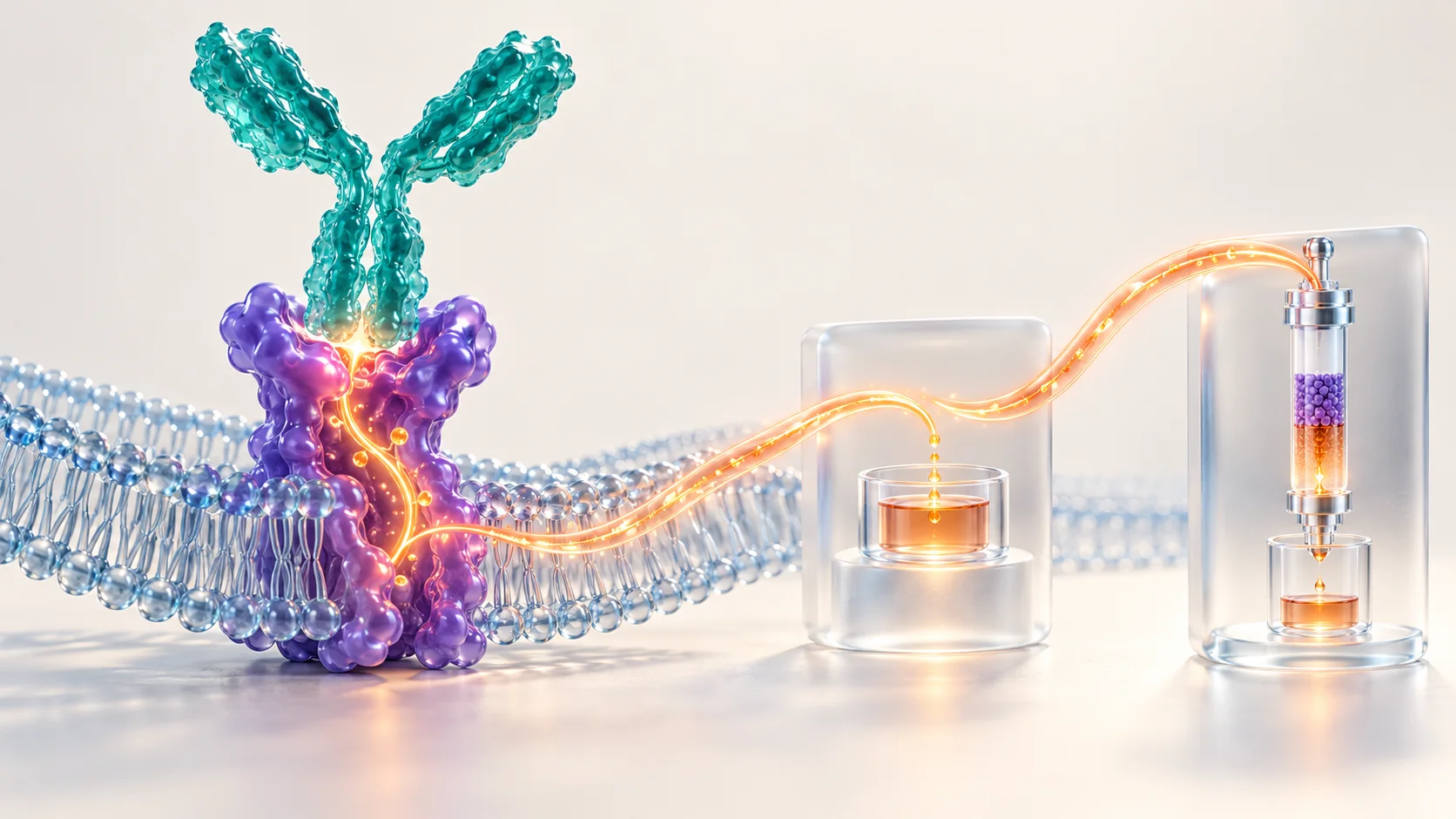
The news hook: designed antibodies with reported cell activity
On October 27, 2026, Pythia Labs announced its launch alongside a preprint describing Pythia-1, an all-atom generative model for antibody design. The company reports full-length human IgG candidates across 22 targets and cell-based examples of GPCR activation and inhibition. These are company-reported findings from an unreviewed preprint, rather than clinical evidence.
We reviewed the dated Business Wire announcement as carried by AFP and the authors’ abstract imported from bioRxiv by Life Science Network. The full preprint was not retrievable in this review. Those sources support a discussion of the reported scope, but not a complete appraisal of individual experiments. We have not verified independent replication.
The founder question is what to do with an encouraging functional result. A binding measurement, a change in receptor signaling and a favorable material property can each justify further work. They should not be compressed into a single label that implies the candidate has cleared every development question.
What changed: the functional objective enters the design discussion
The authors describe designing with explicit specifications, including epitopes and target conformations, and report antibodies with agonist and antagonist activity. The practical distinction is straightforward: binding to a receptor does not by itself specify whether the desired outcome is to activate it, inhibit it or leave a particular signaling response unchanged.
Our interpretation is that founders should review the biological objective alongside the design campaign, rather than treat function as a later annotation on a ranked binding list. A molecule can be interesting for one objective and unsuitable for another. A strong result in the wrong functional direction is not a small scoring error.
This does not make a cell assay a complete model of a therapeutic setting. The proposal is narrower: record what the assay can support, how that relates to the intended action and which alternative explanations remain. That allows the next experiment to resolve a specific uncertainty instead of simply generating more favorable measurements.
A functional hit earns a better next question. It does not answer every development question.THE BIOMEDANA LENS
A hypothetical lead meeting: two antibodies, two different decisions
Imagine a small antibody company pursuing inhibition of a membrane receptor. Candidate A has the stronger binding result in the initial comparison. Candidate B shows the more relevant inhibitory response in the planned cell assay. The team also has preliminary material-characterization results, but the preparations were not all assessed under the same conditions.
A single leaderboard would conceal the disagreement. The biology lead may prefer B because of the observed function. The protein scientist may want to repeat a comparison using consistently prepared material. The founder may be tempted to advance A because its binding result is easier to communicate. None of these positions should be settled by an arbitrary combined score.
We would split the meeting into two decisions. First, does the functional evidence justify continued investigation of the candidate for this objective? Second, is the material evidence sufficiently comparable to support the next development commitment? A candidate might pass the first discussion while remaining conditional in the second. This is an illustrative scenario, not a reconstruction of Pythia’s experiments.
Keep the functional result attached to the material
In this hypothetical program, the first useful record is a map between the antibody design and the material used in each test. For a full-length antibody, keep the paired heavy- and light-chain identities, construct version and preparation identity together. Link the observations to that material rather than only to a short candidate name.
This matters when a result travels from discovery to a team planning expression, purification or more extensive characterization. If one preparation supports the binding comparison and another supports a functional result, reviewers need to see the distinction. A shared name should not imply identical material history.
We would also retain the assay context and comparator with the observation. A favorable response needs a defined interpretation: what was measured, relative to what, and for which intended question? The receiving scientist should be able to identify a proposed comparison that still needs repeating without reconstructing the campaign through informal messages.
Developability is an early question, not a certificate
The company reports that characterized antibodies had biophysical profiles that compared favorably with clinical-stage controls. The abstract also describes incorporating framework and sequence constraints into design. These are reported features of the study; they do not establish that a new design will be straightforward to manufacture at commercial scale.
For a founder, the useful question is which uncertainty an early material assessment removes. Perhaps a result supports preparing more material for the next assay. Perhaps it identifies a concern that merits another comparison. Neither interpretation requires calling the molecule manufacturing-ready.
A practical tradeoff is how much characterization to run before resolving biological uncertainty. Testing everything on every candidate may consume a small team’s capacity. Waiting until a single lead is selected may expose a material problem late. We would use a limited, scientifically justified early panel, then deepen the work as the functional hypothesis earns further investment. The particular panel belongs to the program’s specialists.
The decision framework: advance, hold or investigate a mismatch
A useful framework preserves separate evidence states. It should make it possible to advance functional work while holding a broader claim, or to ask for a matched-material repeat without treating the candidate as a failure. The table below illustrates the decisions we would bring to a review.
Consider candidate B from the hypothetical meeting. If its inhibition result is relevant but material comparability remains unresolved, the next action could be a targeted repeat with a defined preparation and comparator. The team should state what result would change its decision before ordering the work. Otherwise, an inconclusive repeat can produce another meeting with no clearer exit.
The record should also explain a stop decision. A candidate that binds but produces the wrong action for the program may still be scientifically interesting. That is different from being the right lead for this indication hypothesis. Preserving that distinction avoids turning every promising observation into a reason to continue the same branch.
Where scientific software can help without selecting the lead
An assistant could check whether a lead-review pack links each claim to a result and each result to a preparation. It could highlight a missing chain version, a change in comparator or an attempt to describe binding as evidence of inhibition. These are review aids; the system should not infer missing facts to complete a neat story.
For BioMedAna, the useful product idea is an evidence view that lets biology and development teams inspect the same candidate from different questions. Keep the unresolved items visible. A scientist should be able to reject a proposed interpretation while retaining the underlying result.
We would evaluate such a workflow using deliberately inconsistent review packs. Can a reviewer find an assay attached to the wrong preparation? Does the assistant distinguish a missing functional test from an unfavorable one? Does it preserve a conditional decision when someone asks for a one-line summary? Those checks are more informative than whether it can produce a polished candidate narrative.
What we would pass on to another builder
Start with the investment decision your team is actually approaching. It may be a repeat experiment, a larger preparation or a broader characterization package. Define the evidence needed for that commitment, rather than borrowing the language of a much later development milestone.
Then invite the scientist responsible for the next stage into the review. Ask which observation they would reuse, which comparison they would repeat and which uncertainty could change their plan. This exposes the cost of missing context while there is still a chance to repair it.
Pythia’s announcement is timely because it puts reported functional antibody examples alongside design and early material considerations. Our founder lesson is to let those evidence streams inform one decision without pretending they are interchangeable. The most credible next step is the one a team can explain, test and revise when the evidence changes.
A worked review for the hypothetical receptor-inhibition program
Original BioMedAna decision framework. These are illustrative review states, not Pythia results or a universal development protocol.
| Evidence state | Decision it may support | Question still open |
|---|---|---|
| Binding observed; functional action unresolved | Continue the defined functional comparison | Does the antibody produce the intended inhibitory response? |
| Inhibition observed; preparations differ across tests | Plan a targeted matched-material comparison | Will the relevant observation hold for the material being advanced? |
| Relevant function and encouraging early material results | Consider the next characterization commitment | Which application, safety and manufacturing questions remain untested? |
| Binding with the wrong action for this program | Stop or redirect this branch with a rationale | Is there a separately justified objective, rather than a reason to relabel success? |
The questions behind the headline
Does binding establish the intended biological action?
No. In our analysis, binding and the relevant functional response are separate questions. The program must define which action it needs and how the comparison addresses it.
Are these peer-reviewed or clinical results?
The cited work is a company preprint and launch announcement. We reviewed accessible author claims, not a complete full-text evidence package, and do not infer clinical efficacy or safety.
What should a founder ask at the next review?
Which exact material supports each claim, what decision can the result justify, and which comparison would resolve the most consequential remaining uncertainty?
Follow the evidence
- Pythia Labs — October 27, 2026 Business Wire launch announcement, carried by AFP (company release, not AFP reporting) ↗
- Pythia Labs Team et al. — Design of full-length agonist and antagonist antibodies for hard targets, bioRxiv preprint; full text not retrieved ↗
- Authors’ preprint abstract, imported from bioRxiv on October 27, 2026 by Life Science Network ↗
Original BioMedAna editorial analysis. The linked sources support the reported developments; examples, frameworks and product implications reflect our perspective.
Explore the underlying concepts
CONTINUE READING
More from the BioMedAna lens.
 Protein engineering & experimental specifications
Pinal turns words into protein candidates. The experimental brief still needs an owner.
Read perspective ↗ Protein engineering & design decisions
RFD4-Proteina makes protein search more capable. Who chooses what counts as better?
Read perspective ↗ APM in action · Kinetic modelling