INDUSTRY INSIGHTS · APM in action · Kinetic modelling
APM in action: kinetic modelling in BioMedAna Twin
How BioMedAna Twin connects reaction records, kinetic equations, parameter fitting, held-out evaluation and what-if scenarios in one scientific workflow.
Implementation reviewed:
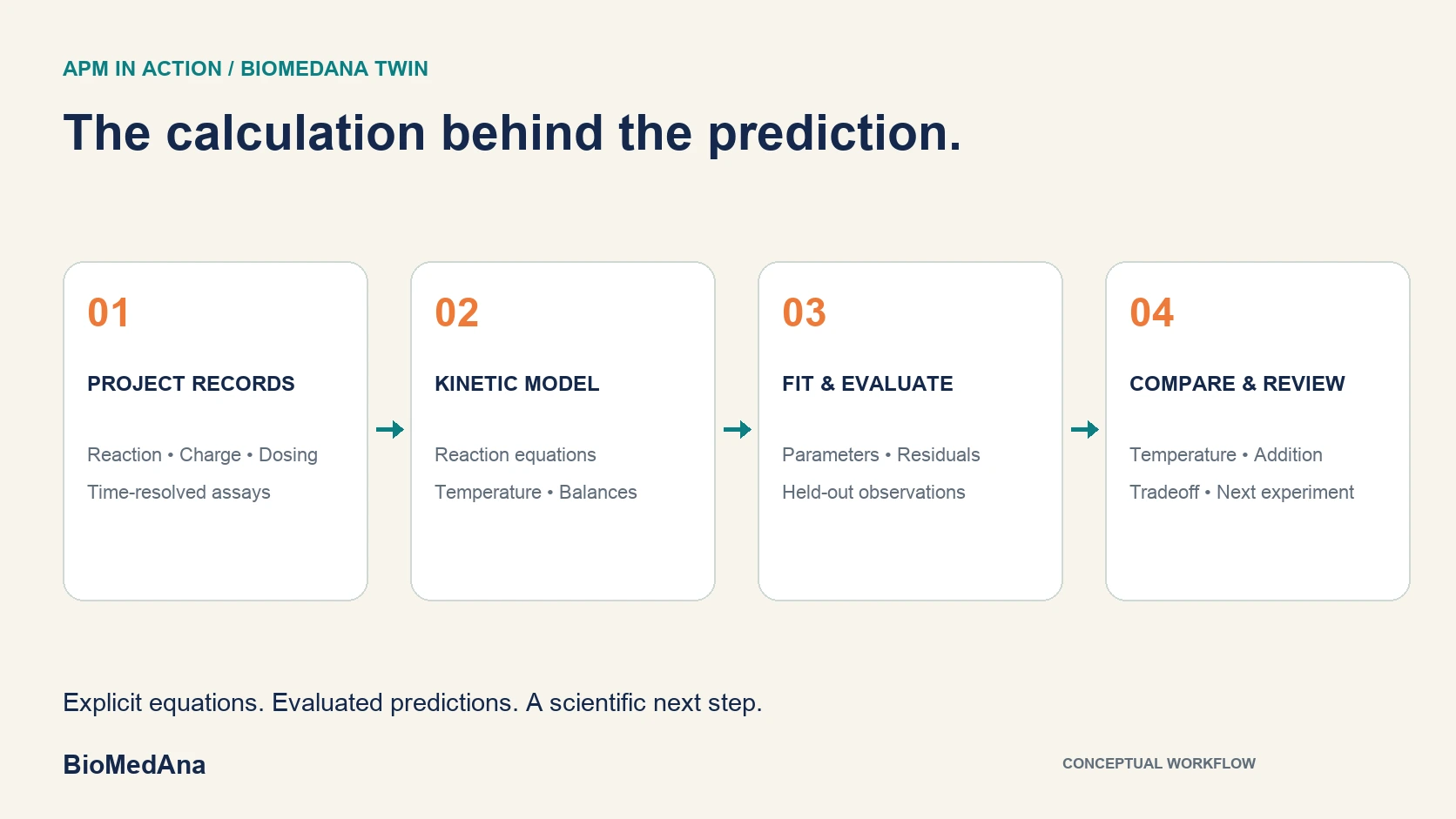
From a process question to an executable model
How would a temperature change alter conversion and impurity formation? Would a different addition schedule improve selectivity? These are questions for a scientific model tied to a reaction and its observations. In BioMedAna Twin, the Reaction kinetics workspace gives that work an explicit numerical basis.
This APM in action walkthrough describes the kinetic-modelling workflow implemented in our Chemical / Small-Molecule API Twin. The screen names are Reaction kinetics, Calibration and Hybrid. Here, APM refers to that predictive-modelling workflow; the equations, data and evaluation remain visible rather than being hidden behind a generated answer.
Start from the project’s reaction and assay records
The project-data path reads committed reaction and analytical records. It builds the reaction network, initial species concentrations, working volume, dosing schedule and concentration observations over time. Recorded runs can be selected in the workspace, with their available conditions carried into the modelling task.
This matters when a reaction involves a desired product and a competing impurity. A final assay value alone loses the trajectory. Keeping reactant, product and impurity measurements at the same time points lets a scientist evaluate whether the proposed network describes the observed course. Missing concentration assays or charge records block the project-context calculation; mapping warnings need review.
A useful prediction exposes the calculation, the evidence that tests it and the experiment that should come next.THE BIOMEDANA LENS
Solve the reaction network under the stated conditions
The core kinetics service integrates differential equations with SciPy. It represents species, stoichiometric pathways, rate parameters and temperature dependence through the Arrhenius relationship. Temperature is converted to Kelvin for that calculation. Supported numerical solver choices include Radau, BDF and RK45.
Batch and semi-batch requests can include reagent addition and changing liquid volume. Thermal options include isothermal conditions, a programmed temperature ramp and a jacket heat-transfer model. The return includes time-dependent concentrations and amounts, temperature and volume, conversion, selectivity, theoretical reaction yield and impurity progression.
The calculation is conditional on the supplied network and inputs. Its theoretical reaction yield is not an isolated or recovered manufacturing yield. Supplying molecular weights enables the network’s gravimetric consistency check; absent molecular-weight information does not establish mass conservation.
Fit parameters and inspect what the data can identify
Calibration fits selected reactions’ Arrhenius pre-exponential factors and activation energies against concentration observations using nonlinear least squares. The result exposes fitted parameters, observed-versus-predicted values, residuals, covariance-based parameter confidence intervals and an identifiability status.
The project-calibration path groups exact duplicate campaigns, uses representative training campaigns and reserves the final distinct campaign for validation. The estimator also rejects overlapping training and validation run IDs. These controls reduce obvious leakage, but distinct records alone do not prove independent experimental coverage.
A visually good fit can still leave correlated or weakly identified parameters. Review that diagnostic before using the fitted model for a new condition. Parameter confidence intervals are not automatically prediction intervals for future product quality.
APM in action: compare temperature and dosing choices
Consider a development question with a desired pathway A + B → C and a competing pathway A + B → D. The scientist starts from the recorded baseline, checks the network and units, and evaluates its fit to the available assays. The product and impurity paths may respond differently to temperature; the direction of the tradeoff depends on the fitted parameters.
In the what-if workflow, create a lower-temperature case and a higher-temperature case while retaining the same network and starting charge. Compare conversion, selectivity, theoretical yield and impurity trajectories, rather than selecting whichever case consumes starting material fastest. Then examine a changed reagent-addition schedule as a separate scenario, retaining the other assumptions.
The useful output is a reviewable candidate experiment: the changed setting, its predicted tradeoffs, the model and data used, and the measurements that would test it. The scientist decides whether the comparison is supported by the existing evidence and proposes the next experiment. This walkthrough illustrates the implemented workflow; it does not report a customer batch result or a measured improvement.
Add a learned correction only when it earns its place
The Hybrid workflow combines the reaction-model baseline with Gaussian-process residual models trained on run observations. The residual model learns discrepancies between the calculated and observed species concentrations using features such as time, temperature, volume and conversion proxy.
With leave-one-run-out evaluation enabled and enough runs for that evaluation, the implementation compares hybrid and mechanistic errors on held-out runs. A species correction is retained only when its held-out RMSE improves on the mechanistic baseline. Without held-out evaluation evidence, that correction is not retained. This makes the learned component accountable to a measured comparison.
A residual correction does not identify the physical cause of a discrepancy, and improvement within those runs does not establish performance beyond their applicability range. Review the evidence for each proposed use.
How the scientific engine and AI work together
BioMedAna’s distinction is the executable scientific work underneath the interaction: explicit reaction equations, numerical integration, parameter estimation, scenario calculations and evaluated data-driven corrections. Those components produce the numerical results. Language assistance can support interpretation and coordination around them; a fluent explanation does not substitute for running the model.
For an evaluation, ask to follow one project from its input records through its calibration result and scenario comparison. Inspect both the predicted behavior and the reasons to restrict its use. Judge the implementation by that evidence trail and the next experiment it helps the team design.
Where reaction modelling meets the stability discussion
Temperature-dependent kinetics, parameter estimation and held-out evaluation also matter in stability modelling. That is why these capabilities are relevant to the wider discussion. A chemical reaction model and an attribute-specific biologics stability model nevertheless have different data, assumptions and receiving decisions.
Using this foundation for shelf-life estimation or a temperature-excursion assessment would require the relevant product, formulation, container and analytical evidence, an appropriate model and its evaluation for that use. The implemented reaction workflow demonstrates numerical modelling capability; it does not confer qualified stability or batch-disposition authority.
What to inspect in an APM demonstration
Use one representative reaction and its observations to follow the whole workflow.
| Stage | Inspect | Receiving question |
|---|---|---|
| Project context | Reaction, charge, dosing and concentration records | Do the records describe the same run and material basis? |
| Numerical model | Network, rate laws, thermal profile and solver result | Are the stated assumptions appropriate? |
| Calibration | Fitted parameters, residuals and identifiability | Can these data support the proposed parameter estimates? |
| Evaluation | Training/held-out split and per-run errors | What evidence tests the fitted model? |
| Hybrid correction | Mechanistic versus hybrid held-out error | Does the correction improve a relevant comparison? |
| Scenario review | Changed input, predicted tradeoff and next measurement | Which experiment should test this candidate? |
The questions behind the headline
What does APM mean in this walkthrough?
It is the predictive kinetic-modelling workflow in BioMedAna Twin. The product screens are Reaction kinetics, Calibration and Hybrid.
Does an LLM calculate the reaction trajectories?
The described core workflow calculates trajectories by numerical integration of explicit reaction equations. Parameter fitting and hybrid residual evaluation are separate numerical tasks.
Can Twin calibrate from project records?
The project-calibration path uses committed reaction and concentration-assay records, returns project lineage and a training/validation split, and requires suitable distinct recorded campaigns.
Does this establish biologics shelf life?
No. That use requires an attribute-specific model, relevant product and analytical evidence, evaluation for the intended conditions and the applicable quality and regulatory process.
Follow the evidence
- BioMedAna Twin — scientific modelling workspace ↗
- BioMedAna — reaction kinetics modelling for pharmaceutical APIs ↗
- BioMedAna — scientific evidence and evaluation ↗
Original BioMedAna editorial analysis. The linked sources support the reported developments; examples, frameworks and product implications reflect our perspective.
Explore the underlying concepts
CONTINUE READING
More from the BioMedAna lens.
 Antibody engineering & lead decisions
Pythia designs antibodies that change receptor activity. What should a founder advance?
Read perspective ↗ Protein engineering & experimental specifications
Pinal turns words into protein candidates. The experimental brief still needs an owner.
Read perspective ↗ Protein engineering & design decisions